

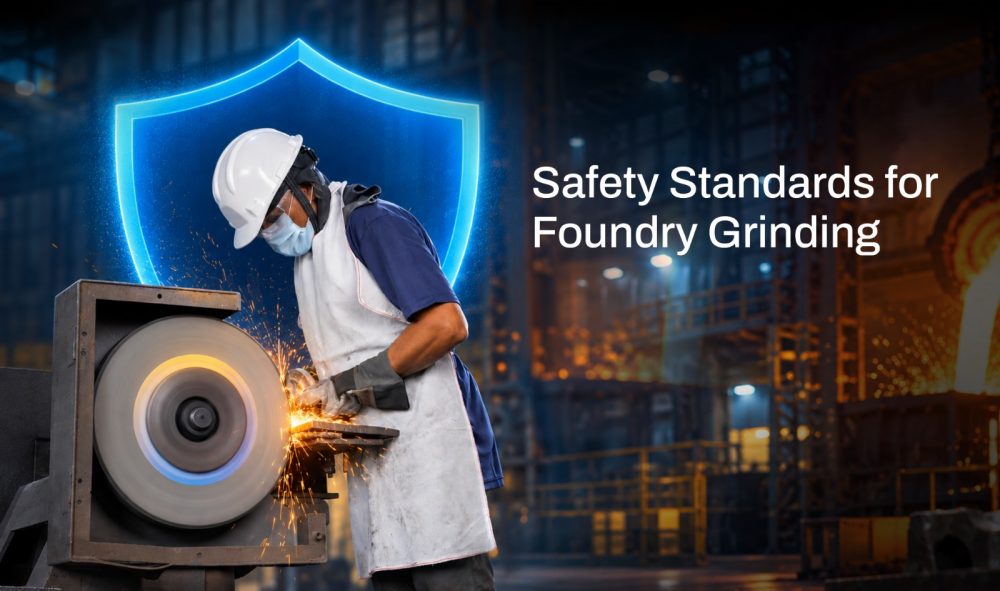
Quick Summary: Safe foundry grinding depends on strict adherence to international safety certifications (EN 12413 and ANSI B7.1), the Indian standards (BIS) your procurement team asks for, RPM matching, pre-use inspection including ring tests, correct wheel selection,the right operator PPE, correct wheel storage, and following manufacturer instructions.
Foundry grinding is demanding work, involving heavy material removal, fettling and dimensional correction of castings and forgings.
Why Is Grinding Wheel Safety Important in Foundries?
Castings carry excess material, gates, risers and flash that need aggressive removal to meet dimensional and surface specifications. CUMI’s Foundry & Forging range includes Resinoid Snagging Wheels for this work. The main causes of wheel failure are incorrect RPM, improper mounting, misalignment, excessive side pressure and thermal stress.
Core Safety Standards: EN 12413 vs. ANSI B7.1
| Standard | Region | What It Governs |
| EN 12413 | European | Design, structural strength, manufacturing process controls and quality checks for bonded abrasives |
| ANSI B7.1 | American | User-side safety: handling, storage, mounting, wheel guards, machine speed limits, operating procedures |
| BIS (IS standards) | India | Indian specifications for bonded abrasive products, often referred to in domestic procurement and tenders |
EN 12413 matters most for heavy stock removal, fettling, riser and runner removal, and grinding cast or forged parts. ANSI B7.1 matters because wheel choice must match the machine and application, especially on portable, angle or swing-frame grinders.
BIS and Indian Standards for Foundry Grinding Wheels
Most foundries CUMI supplies are in India’s industrial belts, including Maharashtra, Gujarat, Tamil Nadu and Punjab. For these buyers, Bureau of Indian Standards (BIS) specifications often matter as much as EN or ANSI standards. Procurement managers at PSUs, OEM-supplying foundries and large forging units commonly ask suppliers to confirm compliance with the relevant IS standards for bonded abrasives before approving a vendor.
What to check when sourcing foundry wheels in India:
- The wheel and its supplier meet the IS standard named in your purchase specification or tender.
- The wheel is marked with its maximum operating speed, size, specification and expiry date.
- The supplier can provide test certificates and quality documentation on request.
- The wheel suits your machine, as set out in your plant’s safety procedures under the Factories Act, 1948 and your state factory rules.
As part of the 124-year-old Murugappa Group, CUMI has manufactured abrasives in India since 1954. It supports domestic buyers with product specifications, catalogues and quality documentation for vendor approval.
4 Pre-Operation Checks Before Using a Foundry Wheel
1. Verify Maximum Operating Speed (RPM)
Machine speed must never exceed the wheel’s rated maximum. Confirm diameter, max RPM, machine RPM, specification and compatibility. Don’t assume a wheel suits another machine.
2. Inspect the Wheel Before Mounting
Check for visible damage or cracks. Perform a ring test where applicable: tap the wheel lightly with a non-metallic object. A clear metallic ring suggests the wheel is sound, while a dull thud suggests internal cracks. Don’t use damaged wheels.
3. Check the Expiry Date
Resinoid bonds degrade over time, and humidity speeds this up. Check the expiry date and identification stamped on the wheel before installation. See the storage section below for how to protect wheels between delivery and use.
4.Select the Correct Wheel and Ensure Machine/Flange Compatibility
Verify diameter, bore size and guard setup. Never force a wheel onto an oversized spindle or modify flanges.
Safety Warning: The main causes of wheel failure are incorrect RPM, improper mounting, misalignment, excessive side pressure and thermal stress.
PPE Requirements for Foundry Grinding Operations
Wheel safety protects the machine. PPE protects the operator. Foundry grinding produces sparks, hot metal fragments, heavy dust and high noise, so every operator needs the right protective equipment before starting.
| PPE | Why It’s Needed in Foundry Grinding |
| Safety glasses + full face shield | Protects against sparks, hot chips and wheel fragments. A face shield alone is not enough, so wear safety glasses under it. |
| Hearing protection | Snagging and swing-frame grinding often run above safe noise levels for long shifts |
| Heat-resistant leather gloves | Protects hands from hot castings and sparks |
| Respiratory protection (dust mask / respirator) | Grinding castings releases metal dust and silica from sand moulds |
| Leather apron or flame-resistant clothing | Protects the body from sparks and hot particles |
| Safety footwear | Protects against heavy castings and dropped wheels |
PPE rules for the shop floor:
- Never grind without eye protection. It is a legal requirement for grinding under the Factories Act, 1948.
- Avoid loose clothing, loose sleeves and jewellery near rotating wheels.
- Stand to one side of the wheel when starting it, and let it run for a short time before grinding.
- Replace damaged face shields, worn gloves and clogged respirator filters immediately.
- Use local exhaust or dust extraction wherever possible, alongside respirators.
CUMI Foundry & Forging Wheel Selector
| CUMI Product | Primary Application | Target Material | Equipment / Machine |
| HI-CARB DC Foundry Wheel | Heavy stock removal, cast iron grinding | Ductile & Cast Iron | Angle Grinders |
| PRO Max 16 Hot Press Wheel | Casting fettling, heavy riser/runner removal | Stainless, High-Alloy & Carbon Steel | Swing-Frame Grinders |
| HI-CUT DC Wheel | Weld blending, edge grinding, deburring | Cast Iron, Carbon & Stainless Steel | Portable Angle Grinders |
| AGNI-S DC Wheel | Heavy stock removal, high-pressure grinding | Heavy Forgings & Structural Steel | Heavy-Duty Angle Grinders |
| Samurai DC Grinding Wheel | Routine maintenance, light metal removal | Mild Steel & General Metals | Standard Angle Grinders |
| Portable Snagging Wheel | Aggressive bulk stock removal | Steel Fabrication & Castings | Portable Snagging Grinders |
Product Notes
- HI-CARB DC Foundry Wheel: Heavy-duty depressed-centre wheel for cast and ductile iron, in 180 mm and 230 mm sizes.
- CUMI PRO Max 16 Hot Press Wheel: For swing-frame grinders, with zirconia grains for stainless, high-alloy and carbon steel.
- HI-CUT DC Wheel: Type 27 depressed-centre wheel for blending, edge grinding, deburring and tool sharpening.
- AGNI-S DC Wheel: Heavy-duty depressed-centre wheel with a reinforced resin bond for controlled, aggressive removal.
- Samurai DC Grinding Wheel: For routine grinding and cutting, with self-sharpening grains and reduced dust and fumes.
- Portable Snagging Wheel: For aggressive bulk stock removal on portable snagging grinders.
Application Matching: Foundry Grinding vs. Deburring vs. Runner/Riser Removal
- Foundry grinding/snagging: Resinoid snagging or hot-pressed wheels for heavy removal.
- Deburring: Depressed-centre wheels that remove edges and burrs with minimal chipping.
- Runner and riser removal: High-strength resinoid wheels for cutting through heavy feeders.
Matching the wheel to the operation prevents both premature wear and unsafe failure.
Wheel Storage and Disposal Best Practices
Wheel safety starts the day a bulk delivery reaches your foundry, not when it is mounted. Resinoid wheels can lose strength if they are stored badly, even before their expiry date.
How to Store Grinding Wheels
- Store wheels in a dry, covered area, away from humidity, water, oil and direct sunlight.
- Avoid extreme temperatures. Keep wheels away from furnaces, ovens and freezing conditions.
- Store thin and depressed-centre wheels flat on a level surface. Do not stack heavy items on them.
- Store large, thick snagging wheels upright on their edge in racks with proper support, so they cannot roll or fall.
- Keep wheels in their original packaging until use, with the label and expiry date visible.
- Use first-in, first-out (FIFO) stock rotation so older wheels are used before newer ones.
- Handle wheels carefully. Never drop, roll or throw them, and re-inspect any wheel that has been dropped.
How to Dispose of Used or Expired Wheels
- Remove expired, damaged or dropped wheels from the store immediately and mark them “Do Not Use.”
- Make the wheel unusable before disposal, for example by breaking it safely, so it cannot be picked up and used again.
- Retire wheels once they are worn down to the minimum diameter or flange size recommended by the manufacturer.
- Dispose of used wheels and grinding swarf as industrial waste, following your local and state pollution control board rules.
Frequently Asked Questions
What safety standards apply to grinding wheels?
EN 12413 covers bonded abrasives, and ANSI B7.1 covers use, care and protection. In India, buyers may also ask for the relevant BIS (IS) standards. CUMI says its products follow EN 12413 and ANSI B7.1.
What is a foundry grinding wheel used for?
Heavy removal, surface preparation and shaping of cast or forged parts.
Which CUMI wheel suits heavy foundry grinding?
It depends on material and machine. Use HI-CARB DC for cast and ductile iron, and PRO Max 16 for swing-frame grinding of steels.
What is a snagging grinding wheel?
A wheel for aggressive removal of excess material from rough castings or forgings.
How do I check a wheel before use?
Inspect it for damage, check identification and expiry, verify rated speed and perform a ring test where applicable.
What causes wheel breakage?
Wrong RPM, incorrect mounting, misalignment, thermal stress and sudden side pressure.
Which CUMI wheel suits cast iron?
The HI-CARB DC Foundry Wheel.
What PPE is needed for foundry grinding?
Safety glasses with a face shield, hearing protection, heat-resistant gloves, a respirator, a leather apron and safety shoes.
How should grinding wheels be stored?
In a dry, covered area away from humidity and heat. Thin wheels go flat and large wheels upright in racks, with FIFO rotation.
What should I do with expired grinding wheels?
Mark them “Do Not Use,” make them unusable, and dispose of them as industrial waste. Never mount an expired wheel.
Do Indian foundries need BIS-compliant grinding wheels?
Many PSU and OEM buyers ask for BIS (IS) compliance in tenders and vendor approval. Check your purchase specification and ask your supplier for documentation.
CUMI’s Approach to Safe and Efficient Foundry Grinding
Foundry grinding needs more than high removal rates. The wheel must suit the material, machine and operation, and its speed, condition, mounting and method must be controlled. Safe practice comes down to choosing the right wheel, running it within its limits, and following correct inspection, mounting and grinding practices. It also means protecting operators with the right PPE and storing wheels correctly from delivery to disposal.
Need help choosing the right foundry wheel or getting compliance documents for vendor approval? Call 1800 3000 1131 (toll-free), download the CUMI catalogue at https://cumiabrasive.in/catalogs/, or send an enquiry at https://cumiabrasive.in/contact-us/.
CUMI Abrasives – Carborundum Universal Limited, Dare House Extension, 4th Floor, 234, NSC Bose Road, Chennai, Tamil Nadu 600001. Customer Support: +91-8035120000 | Sales: +91-7845121555