
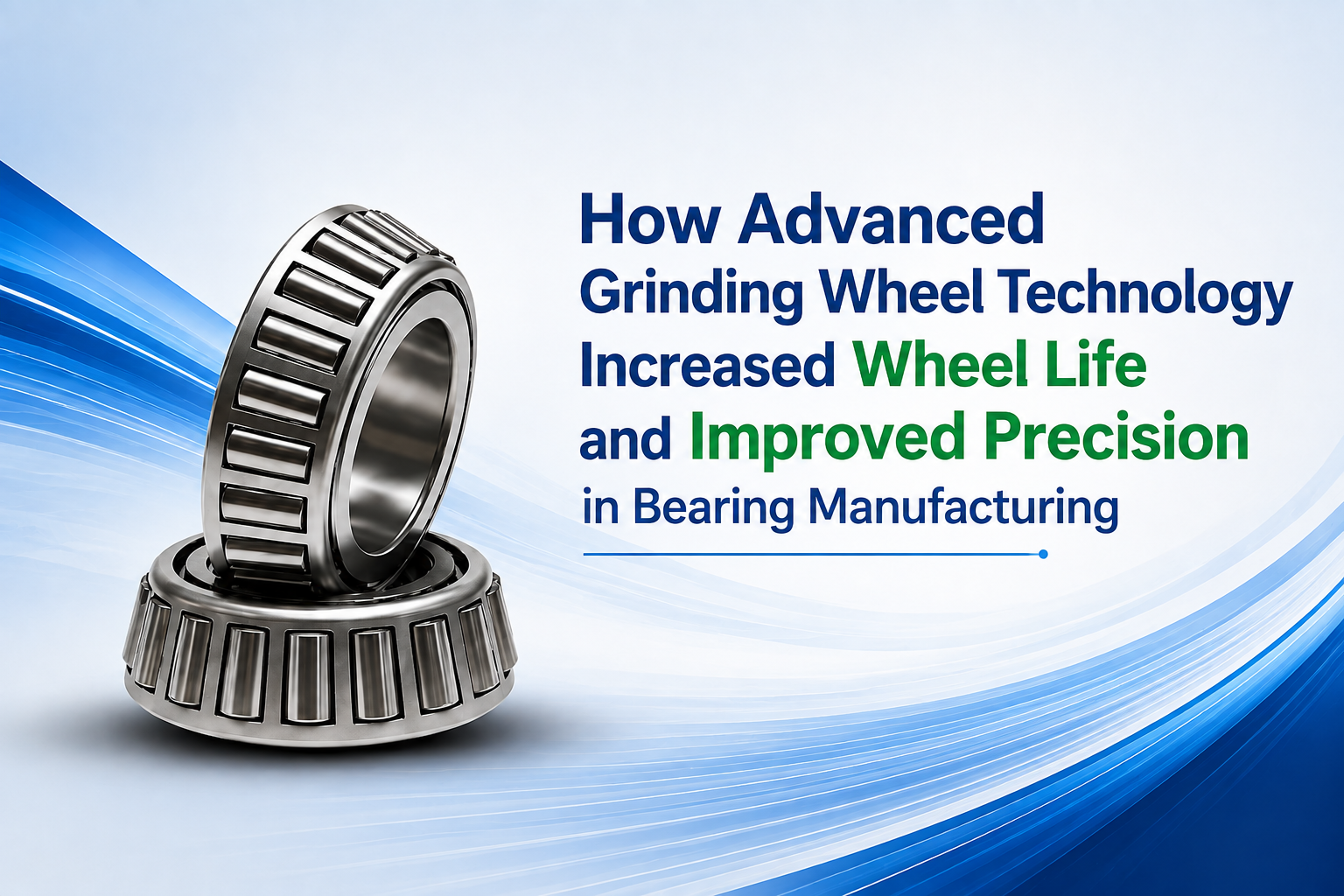
Quick Summary: By switching to CUMI’s Next Generation Epoxy Bond Grinding Wheel for inner ring grinding, a bearing manufacturer increased wheel life by about 30% (to 8,501 components), halved dressing frequency (from every 200 to every 400 components) and improved size accuracy from 20 microns to 7 microns, with no changes to the production line.
Every Micron Matters in Bearing Manufacturing
Inner ring grinding is one of the most demanding finishing steps in bearing production. Wheel performance directly affects wheel life, dressing frequency, machine availability and productivity. Manufacturers track KPIs such as OEE, wheel life and Cost Per Component.
The Manufacturing Challenge
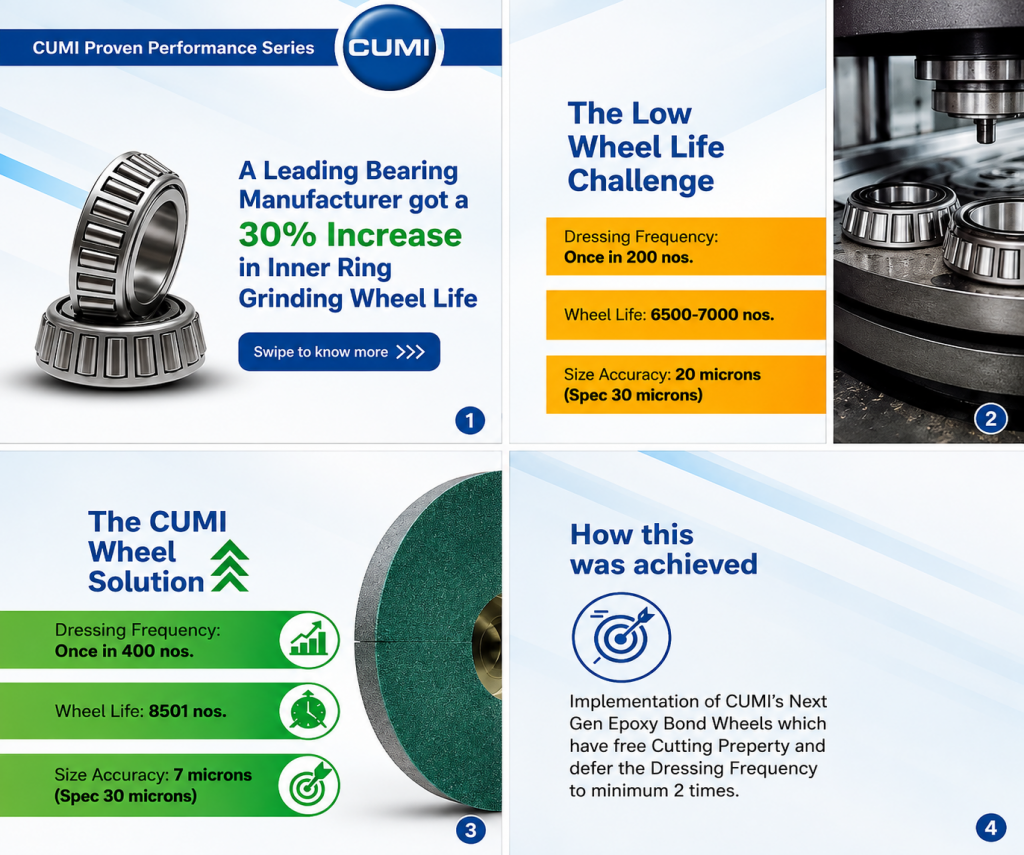
A bearing manufacturer wanted higher productivity without losing accuracy. Its baseline process:
- Dressing required every 200 components
- Wheel life of about 6,500–7,000 components
- Size accuracy of 20 microns against a 30-micron specification
Engineering the Solution
CUMI recommended its Next Generation Epoxy Bond Grinding Wheel for inner ring grinding. This free-cutting wheel is designed to extend dressing intervals and stabilise the process, with no changes to the existing production line.
Choosing the Right Wheel Specification for Bearing Inner Ring Grinding
The results in this case came from matching the wheel specification to the application, not from changing the machine. When you evaluate or request a wheel for inner ring grinding, these are the parameters to define.
| Parameter | What It Controls | What to Consider for Inner Ring Grinding |
| Grain type | Cutting action, heat generation and wheel life | Aluminium oxide or ceramic (sol-gel) grains are commonly used for hardened bearing steel such as 100Cr6 / EN31. Ceramic grains stay sharp longer and reduce dressing. |
| Grit size | Surface finish vs stock removal rate | Finer grits give better finish on raceways. Coarser grits remove stock faster on bores and faces. |
| Hardness grade | How long grains are held before they break away | Too hard causes glazing and burn. Too soft causes fast wear and size variation. |
| Bond type | Wheel stability, free-cutting behaviour and dressing interval | CUMI’s Next Generation Epoxy Bond is designed for free cutting and longer dressing intervals. |
| Structure / porosity | Coolant flow and chip clearance | Open structures help keep the wheel cool and reduce thermal damage on hardened rings. |
| Wheel size & speed | Machine fit and safe operation | Match the wheel diameter, width, bore and maximum speed to your grinding machine. |
What to share with CUMI when requesting a wheel recommendation:
- Bearing type and ring dimensions (bore, OD, width)
- Material and hardness (for example 100Cr6 / EN31, 58–62 HRC)
- Operation: bore, raceway, face or OD grinding
- Machine make, model and wheel speed
- Current wheel specification, wheel life and dressing interval
- Size tolerance and surface finish (Ra) targets
- Coolant type and dressing method
Measured Improvements
| Parameter | Before | After |
| Dressing frequency | Every 200 components | Every 400 components |
| Wheel life | 6,500–7,000 components | 8,501 components |
| Size accuracy | 20 microns | 7 microns |
The result was about 30% higher wheel life.
Why These Improvements Matter
Longer wheel life and less frequent dressing reduce production stoppages, improve machine utilisation, lower tooling consumption and support higher throughput at the same precision. Halving dressing frequency also means the wheel spends more of each shift grinding instead of being dressed, which directly lifts machine availability and OEE.
Industry 4.0 Perspective
Using measurable operating data helps engineering teams find improvement opportunities without major capital spending. Key KPIs include wheel life, dressing frequency, OEE, process capability and machine availability.
Glossary: Key KPIs Used in Bearing Grinding
| Term | What It Means | Why It Matters |
| OEE (Overall Equipment Effectiveness) | Availability × Performance × Quality, shown as a percentage | The standard measure of how productive a grinding machine really is |
| Wheel life | Number of components ground before the wheel must be replaced | Longer wheel life means fewer wheel changes and lower tooling cost |
| Dressing frequency / dressing interval | How often the wheel is dressed to restore its shape and sharpness (e.g. every 400 components) | Every dressing cycle stops production and consumes wheel material |
| G-ratio (grinding ratio) | Volume of workpiece material removed ÷ volume of wheel worn away | A higher G-ratio means the wheel removes more material for every bit of wheel used |
| Cost Per Component (CPC) | Total grinding cost (wheel, dressing, downtime, labour) divided by components produced | A better measure of value than wheel price alone |
| Size accuracy | How close the ground dimension is to the target size, in microns | Tighter accuracy means fewer rejects and less rework |
| Process capability (Cp / Cpk) | How consistently a process stays within its tolerance limits | A higher Cpk means a more stable, predictable process |
| Machine availability | Share of planned time the machine is actually running | Fewer dressing and wheel-change stops raise availability |
Engineering Perspective
Results depend on workpiece material, machine capability, bond technology, wheel specification, coolant conditions and dressing parameters. These results come from an actual bearing manufacturing application. CUMI evaluates the complete grinding process and validates recommendations with objective KPIs.
How to Run a Similar Production Trial with CUMI
Want to see whether your bearing line can achieve similar results? CUMI’s application engineering team runs structured production trials on your own machines, with your own components.
Step 1: Share Your Current Process Data
Send your current wheel specification, wheel life, dressing interval, size accuracy, cycle time and machine details. This becomes the baseline for measuring improvement.
Step 2: Application Study
CUMI’s application engineers review your process, including material, machine, coolant and dressing parameters. If needed, they visit your plant to observe the grinding operation.
Step 3: Wheel Recommendation
CUMI recommends a wheel specification for your application, such as the Next Generation Epoxy Bond Grinding Wheel for inner ring grinding.
Step 4: Production Trial
The recommended wheel is run on your production line under normal conditions, with no changes to your line, while results are recorded against the agreed KPIs.
Step 5: Validation and Report
Trial results are compared with the baseline: wheel life, dressing frequency, size accuracy and cost per component. You get objective data to support your decision.
What to prepare before starting a trial:
- Current wheel specification and supplier
- Baseline KPIs from at least one full wheel life
- Machine make, model and operating parameters
- Quality targets (size tolerance, Ra finish, Cpk)
- A contact person from production or quality for data sharing
Key Takeaways
- Judge grinding performance by measurable KPIs, not wheel price.
- Reduce dressing frequency to improve machine availability.
- Use application-specific abrasive technology.
- Validate improvements through production trials.
- Support Lean Manufacturing and Industry 4.0 initiatives.
- Define grain, grit, grade and bond for your specific operation before requesting a wheel.
Frequently Asked Questions
Why is wheel life important?
Longer wheel life reduces production interruptions and tooling costs.
Why reduce dressing frequency?
Less dressing means more time spent machining.
How does abrasive selection improve accuracy?
Application-specific specifications keep cutting performance stable and dimensions consistent.
Which grinding wheel is best for bearing inner ring grinding?
It depends on ring material, operation and machine. CUMI’s Next Generation Epoxy Bond Grinding Wheel increased wheel life by about 30% in this inner ring application.
What is G-ratio in grinding?
The volume of material removed divided by the volume of wheel worn. A higher G-ratio means better wheel efficiency.
What is OEE in grinding?
Overall Equipment Effectiveness: availability × performance × quality. It shows how productive a grinding machine really is.
How can I run a grinding wheel trial with CUMI?
Share your current process data with CUMI’s application team. They will recommend a wheel and run a production trial on your line.
What information does CUMI need to recommend a bearing grinding wheel?
Ring material and hardness, operation, machine details, current wheel specification, wheel life, dressing interval and quality targets.
Conclusion
Engineering-led optimisation of grinding wheel technology can improve wheel life, reduce dressing and improve precision. This case supports higher productivity and Industry 4.0 goals.
Start a Grinding Trial for Your Bearing Line
Want to increase wheel life and reduce dressing on your bearing grinding line? Talk to CUMI’s application engineering team about a production trial on your own machines.
Call 1800 3000 1131 (toll-free) or Sales: +91-7845121555, download the CUMI catalogue at https://cumiabrasive.in/catalogs/, or send your process details at https://cumiabrasive.in/contact-us/.
As part of the 124-year-old Murugappa Group, CUMI has engineered abrasive solutions for Indian and global manufacturers since 1954. See CUMI’s bearing industry solutions at https://cumiabrasive.in/industries/bearing/.
CUMI Abrasives – Carborundum Universal Limited, Dare House Extension, 4th Floor, 234, NSC Bose Road, Chennai, Tamil Nadu 600001. Customer Support: +91-8035120000 | Sales: +91-7845121555