

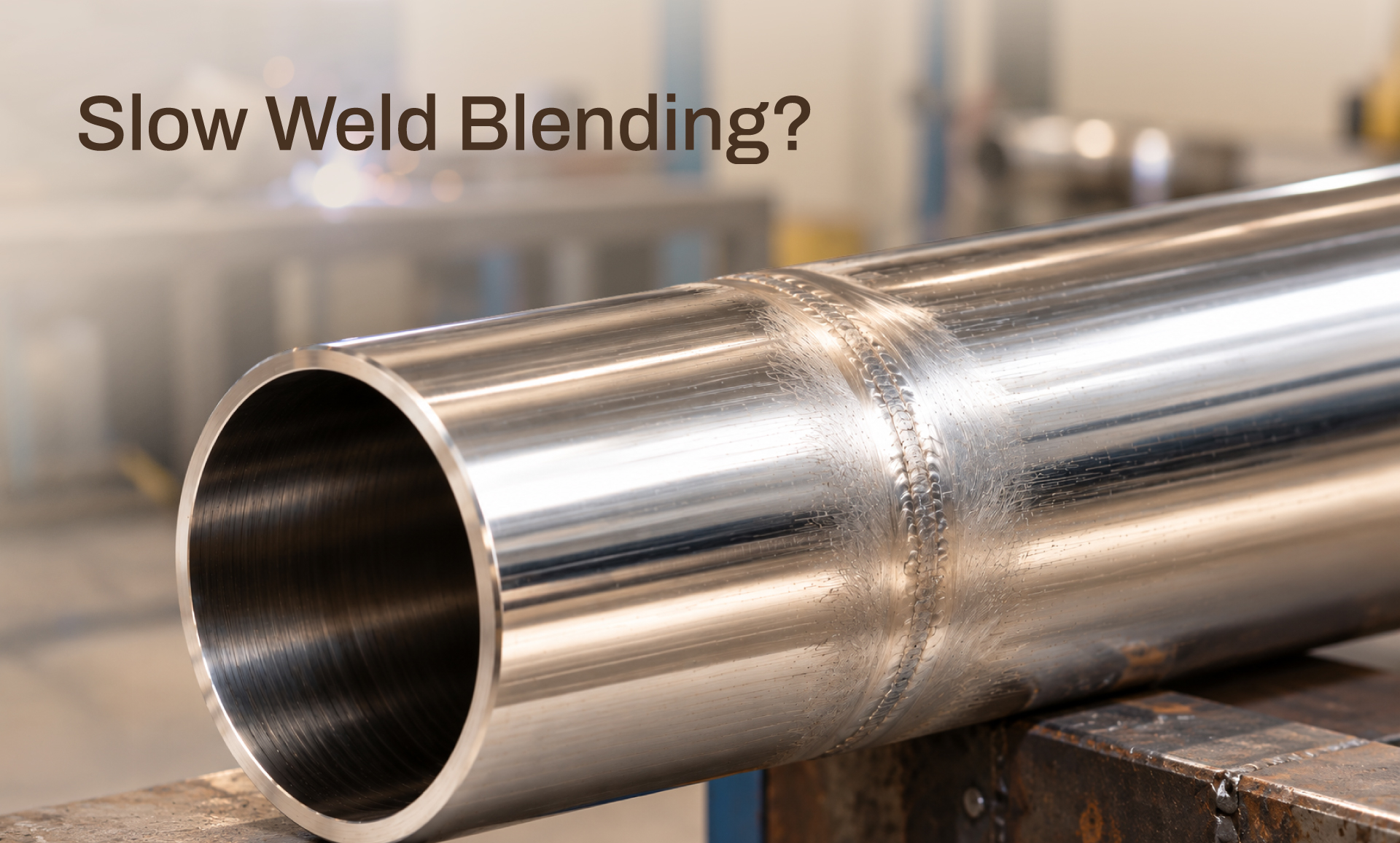
Quick answer: Weld blending on stainless steel takes too long when you use only grinding wheels and flap discs, because each step leaves deep scratches that need even more steps to remove. Using a CUMI non-woven disc after initial grinding lets you blend the weld, remove light discoloration and get a smooth satin finish in fewer passes. Non-woven discs run cooler, don’t gouge the metal and give a consistent finish from the first joint to the last, which saves time, abrasive cost and rework on every stainless steel job.
Why Is Weld Blending on Stainless Steel So Slow?
If your fabricators spend more time finishing welds than actually welding, you’re not alone. This is one of the most common complaints we hear from stainless steel fabrication shops across India, from small MSME workshops to large equipment makers. Stainless steel is tough to finish for a few simple reasons:
- It holds heat. Stainless doesn’t spread heat quickly like mild steel, so aggressive grinding causes blue or gold heat tint around the weld. Removing that tint later adds another step and more time to every joint.
- Deep scratches are hard to remove. A coarse grinding disc removes the weld bead fast but leaves deep lines in the surface. Each finer step after that is spent just removing the scratches left by the step before it.
- Too many disc changes. Many shops go from grinding wheel to 40, 60, 80 and 120 grit flap discs. Every change costs minutes per joint, and across hundreds of joints a month, those minutes turn into lost hours.
- Gouging and rework. Rigid discs can dig into thin sheet or tubes, which means filling, regrinding or even scrapping the part. On costly stainless material, one gouged part can wipe out the savings from a cheaper abrasive.
- Contamination risk. Using the same disc on mild steel and stainless steel can leave iron particles on the surface that later cause rust spots, customer complaints and rejected deliveries.
The fix isn’t working harder or pushing the grinder more. It’s using the right abrasive for each stage of the job. That’s exactly where CUMI non-woven abrasives come in.
What Is a Non-Woven Disc?
A non-woven disc, also called a surface conditioning disc, is made from a 3D web of nylon or synthetic fibres coated with abrasive grain and held together with resin. Unlike a rigid grinding wheel or a flap disc, the web is open, springy and flexible, almost like a tough scrub pad built for metal.
This gives non-woven discs three big advantages when blending welds on stainless steel:
- They flex with the surface, so they follow curves, corners, fillet welds and tube profiles without digging in or leaving flat spots.
- They run cooler, because the open web lets heat escape instead of trapping it, which greatly reduces heat tint and warping on thin sheet.
- They wear evenly, so fresh abrasive grain keeps coming to the surface as the disc is used, and the finish stays consistent from the first joint to the last.
CUMI, part of the Murugappa Group and one of India’s pioneers in coated and bonded abrasives, makes a range of non-woven abrasive discs and wheels for cleaning, blending and finishing metal surfaces. These products are built for the real working conditions of Indian fabrication shops, where speed, finish quality and cost per job all matter at the same time.
Non-Woven Disc vs Flap Disc: Which Is Better for Weld Blending?
Both have an important place in weld finishing. The smart move is knowing which one to use at which stage, instead of trying to do the whole job with one disc.
| Flap Disc | CUMI Non-Woven Disc | |
| Best for | Removing the weld bead fast and levelling heavy welds | Blending, cleaning and finishing the weld area |
| Cutting action | Aggressive, high stock removal | Controlled and gentle, low stock removal |
| Risk of gouging | Higher on thin sheet and tubes | Very low, even on thin material |
| Heat build-up | More, can cause heat tint | Less, thanks to the open fibre web |
| Finish | Visible grinding lines | Smooth, uniform satin finish |
| Steps needed after | Usually 2–3 more finishing steps | Often ready for final finish or polish |
In short: use a flap disc to knock the weld down quickly, then switch to a CUMI non-woven disc to blend it in cleanly. Using both together is faster than using either one alone.
How to Blend Welds on Stainless Steel Faster: CUMI’s 4-Step Method
Here’s a simple, proven workflow that cuts finishing time for most stainless steel fabrication jobs, whether you’re working on tanks, frames, railings or pipe:
Step 1: Remove the Weld Bead
Use a CUMI flap disc or fibre disc to grind the weld close to the surface. Don’t grind it fully flat. Leave a little height for the next step so you don’t thin or weaken the base metal. Keep the disc at a low angle and move along the weld rather than staying in one spot.
Step 2: Blend With a Coarse or Medium Non-Woven Disc
Switch to a CUMI non-woven disc in coarse or medium grade. Work across the weld with light, even pressure. This removes the grinding lines from Step 1, blends the weld smoothly into the surrounding metal and clears light heat discoloration, all in one pass. This is the step where most of the time saving happens.
Step 3: Refine With a Fine Non-Woven Disc
Move to a fine grade CUMI non-woven disc to get a uniform satin or brushed look. Keep the tool moving and follow the direction of the existing grain on the sheet, so the repaired area matches the rest of the surface and the weld becomes almost invisible.
Step 4: Final Polish
For mirror or decorative finishes, such as kitchen equipment or architectural work, follow with CUMI polishing products. For most industrial and structural jobs, Step 3 already gives a finish that’s ready for delivery.
Result: Instead of four or five flap disc changes, you get a clean, consistent finish in two or three steps, with less operator effort, less heat damage and lower abrasive use per joint.
Tips to Get the Most Out of Non-Woven Discs
- Let the disc do the work. Heavy pressure creates heat, glazes the web and wears the disc faster. Light, steady pressure gives a better finish and longer disc life.
- Use the right speed. Always check the maximum RPM marked on the disc and match it to your angle grinder. Running too fast can overheat the disc and the workpiece.
- Keep it moving. Staying in one spot causes heat tint, low spots and an uneven finish. Smooth, overlapping strokes give the best result.
- Keep stainless abrasives separate. Mark discs used for stainless and never use them on mild steel. This simple habit avoids iron contamination and rust spots later.
- Choose the right grade. Coarse for blending welds, medium for general cleaning and blending, and fine for final satin finishing. Picking the right grade first time saves both time and discs.
Where CUMI Non-Woven Discs Make the Biggest Difference
Fabricators across India use CUMI abrasives for fast, clean weld finishing in:
- Food processing and dairy equipment, where smooth, crevice-free welds matter for hygiene and easy cleaning
- Pharmaceutical tanks and vessels, where surface finish quality is closely checked
- Stainless steel railings, kitchen equipment and furniture, where the finish must look good to the end customer
- Railway coaches and automotive parts, where high volumes demand fast and repeatable finishing
- Pipe and tube fabrication, where curved surfaces need a flexible disc that follows the shape
Why Fabricators Choose CUMI
CUMI (Carborundum Universal Limited) has been building abrasives in India for decades as part of the Murugappa Group, one of the country’s most trusted industrial groups. With a full range of coated abrasives,flap discs, cutting and grinding wheels and non-woven products, CUMI covers every step of weld finishing, from cutting and grinding to blending and polishing, all from one reliable brand.
CUMI’s application support team can visit your shop, study your current weld finishing process and suggest the right disc sequence to cut finishing time, reduce abrasive cost and improve finish quality on every stainless steel job.
Frequently Asked Questions
What is the fastest way to blend welds on stainless steel?
Grind the weld bead down with a flap disc, then switch to a non-woven disc to blend and finish. This reduces the number of disc changes, keeps heat low and gives a smooth, even finish much faster than using flap discs alone.
Can non-woven discs remove weld discoloration?
Yes. Non-woven discs can remove light heat tint and discoloration around welds while blending the surface at the same time. Heavy discoloration may still need chemical pickling or passivation depending on the job and customer requirements.
What is a non-woven disc used for?
Non-woven discs are used for weld blending, cleaning, deburring, removing light rust and oxide, and creating satin or brushed finishes on metals like stainless steel, aluminium and mild steel.
Is a non-woven disc better than a flap disc for stainless steel?
For blending and finishing, yes. For removing a large weld bead, a flap disc is faster. Most shops get the best results and the shortest finishing time by using both in sequence.
Will non-woven discs damage thin stainless sheet?
No. Their flexible fibre web cuts gently and stays cooler, so it’s much less likely to gouge, burn or warp thin sheet compared to rigid grinding discs.
Which grade of non-woven disc should I use?
Use coarse for blending welds, medium for general cleaning and blending, and fine for final satin finishing. If you’re unsure, start with medium and adjust based on the finish you need.
Cut Your Weld Finishing Time With CUMI
Stop losing hours on every stainless steel job. Talk to CUMI’s abrasive experts to find the right non-woven disc and finishing sequence for your shop, your material and your finish requirements. Call our toll-free number 1800 3000 1131 or download the product catalogue