
Quick answer: Stainless steel needs a dedicated cutting Wheel — never the same wheel used on mild steel or carbon steel. A proper stainless steel (“inox”) cutting wheel is free of iron, sulfur, and chlorine fillers that cause surface contamination and rust spotting, runs cooler to avoid heat discoloration and warping, and is typically thinner to reduce burr and minimize the heat-affected zone. Using a general-purpose or ferrous-only wheel on stainless steel is the single most common cause of rejected welds, rust staining, and rework in fabrication shops.
For fabricators, cutting wheel look interchangeable at a glance — same shape, same bore size, similar price. But stainless steel behaves very differently under an abrasive wheel than mild steel does, and the wrong wheel choice shows up later as corrosion, rejected components, or failed weld inspections. This guide covers what actually differentiates a stainless-rated (“Inox”) cutting wheel, how to choose one, and where fabricators most often get it wrong — with real product examples from CUMI (Carborundum Universal Ltd.), a Murugappa Group company manufacturing abrasives in India since 1954.
Why Stainless Steel Needs a Different Cutting Wheels
1. Contamination Is the #1 Risk
The problem: Standard cutting wheels used on carbon or mild steel often contain iron, sulfur, and chlorine as filler or bonding agents. When these wheels are used on stainless steel, trace iron particles embed into the cut surface. Over time — especially in humid or washdown environments — those embedded particles rust, causing visible surface staining (“free iron contamination”) even though the stainless itself hasn’t corroded.
Why it matters for fabricators: This is invisible at the time of cutting and often only shows up weeks later, after the component has shipped or been installed — making it one of the costliest quality issues to trace back.
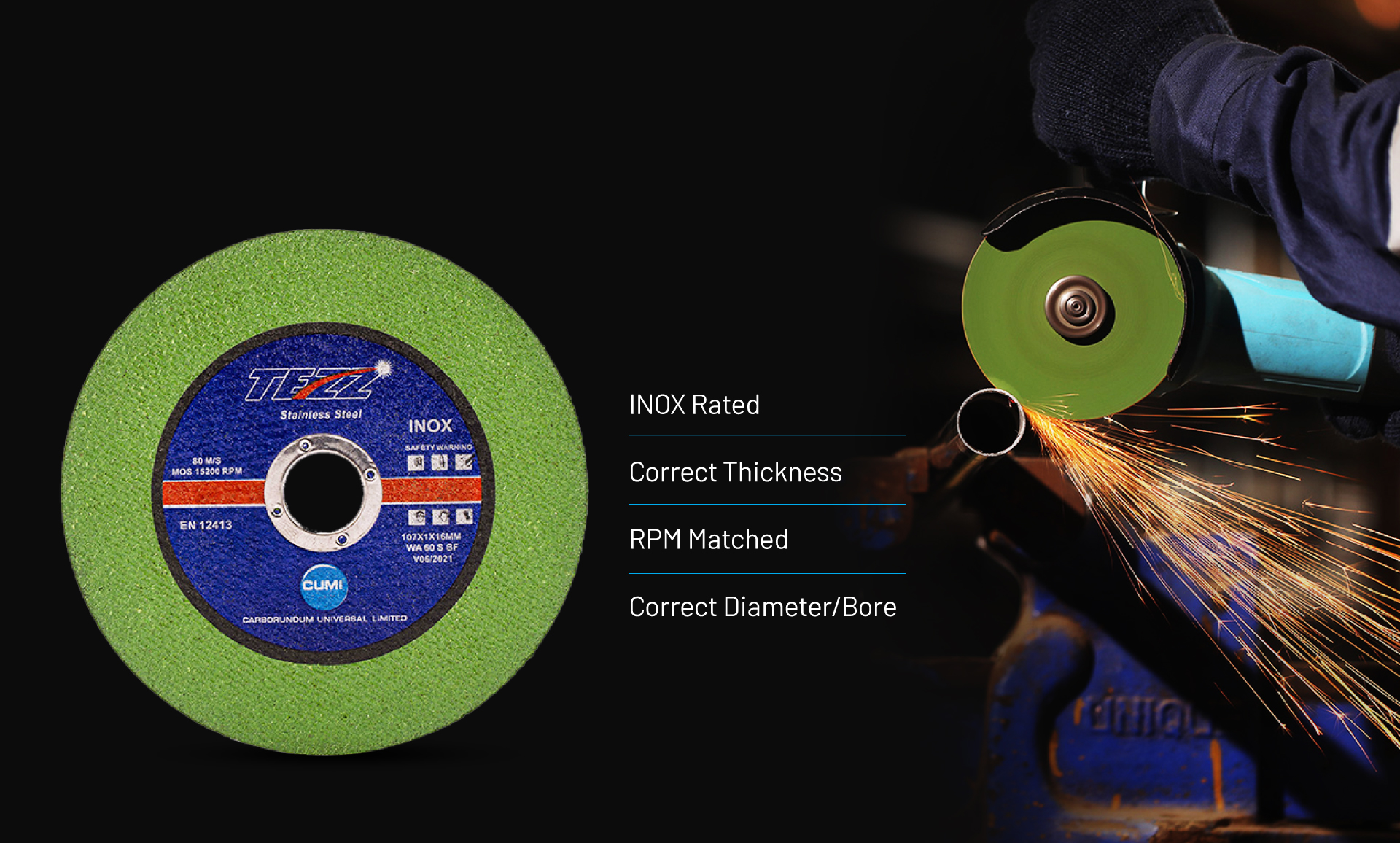
What to use instead: A wheel explicitly labeled “Inox” or stainless-rated, formulated without iron, sulfur, or chlorine fillers. CUMI’s Tezz Inox Ultra Thin Wheel and Samurai Cutting Wheel are built specifically for stainless and mild steel cutting without cross-contamination risk.
2. Heat Buildup Causes Discoloration and Distortion
The problem: Stainless steel has lower thermal conductivity than mild steel, so heat generated during cutting doesn’t dissipate as quickly — it concentrates at the cut edge. Excess heat causes blue/brown discoloration (temper colors), can alter the material’s corrosion resistance near the cut, and warps thin-gauge sheet.
What to check: Cutting speed, feed pressure, and whether the wheel is designed for a “cool cutting” action rather than pure aggressive stock removal.
What to use instead: Thinner, reinforced wheels designed for fast, low-heat separation. CUMI’s Sleek Ultra Thin Wheel is built for precise 90-degree cuts on stainless with reduced heat zones, and CUMI’s Ceramic Belt YS 592 (used in blade and sheet cutting applications) is specifically engineered for clean separation with minimal heat input.
3. Burr Formation Affects Weld Prep and Finish Quality
The problem: A wheel that’s too thick, too coarse, or run at the wrong feed rate leaves heavy burrs on the cut edge. On stainless fabrication — especially for food-grade, architectural, or medical components — burrs mean extra deburring labor and inconsistent weld gaps.
What to use instead: Ultra-thin reinforced wheels are the fabrication standard for stainless because they remove less material per pass, run cooler, and leave a cleaner edge that needs less finishing. CUMI’s Green 2 Net Ultra Thin Wheel and Concord Ultra Thin Wheel are designed for this precision-cutting profile.
4. Wheel Speed Rating vs. Machine Speed
The problem: As with grinding wheels, running a cutting wheel above its rated maximum operating speed (MOS) is a serious safety risk, and running it below rated speed causes inefficient, higher-heat cutting.
What to check: Always confirm the wheels printed MOS against the actual RPM of the angle grinder or chop saw — not just the machine’s speed setting, which can drift due to voltage fluctuation or motor wear, especially on older equipment common in MSME fabrication shops.
What to use instead: For high-volume stainless cutting on chop saws, CUMI’s CUMI NXT Chopsaw, CUMI Green Chopsaw DF, and CUMI DF Chopsaw wheels are matched to standard chop saw speeds for bar, pipe, and profile cutting in stainless and alloy grades.
Cutting Wheel Selection Checklist for Stainless Steel
Use this before ordering or restocking cutting wheels for a stainless fabrication job:
- Wheel is explicitly labeled for stainless/Inox use — not a general-purpose or mild-steel-only wheel
- No iron, sulfur, or chlorine fillers in the bond (check the manufacturer’s technical data sheet if unsure)
- Wheel thickness matches the job — ultra-thin (0.8–1.0mm range) for precision fabrication cuts, reinforced (RFC) for heavier bar and profile cutting
- Maximum operating speed (MOS) is confirmed against actual grinder/chop saw RPM
- Wheel diameter and bore size match the machine — never force-fit a wheel with an adapter bushing
- Storage is dry and separated from carbon-steel-rated wheels to avoid accidental cross-use
- A separate stock of stainless-only wheels exists if the same shop also cuts mild/carbon steel
Quick Reference: Symptom vs. Likely Wheels-Related Cause
| SYMPTOM ON THE SHOP FLOOR | LIKELY CAUSE | WHAT TO CHANGE |
|---|---|---|
| Rust spots appear on stainless weeks after cutting | Free iron contamination from a non-Inox wheel | Switch to a dedicated stainless-rated wheel (e.g. Tezz Inox, Samurai Cutting Wheel) |
| Blue/brown discoloration at the cut edge | Excess heat buildup during cutting | Use a thinner, cooler-cutting wheel (e.g. Sleek Ultra Thin); reduce feed pressure |
| Heavy burr requiring extra deburring | Wheel too thick or coarse for the gauge | Switch to an ultra-thin wheel (e.g. Green 2 Net, Concord Ultra Thin) |
| Warping on thin-gauge sheet after cutting | Heat concentration from slow, high-pressure cutting | Increase cutting speed, reduce dwell time, use a reinforced chopsaw wheel |
| Wheel wears out unusually fast on stainless | Wrong grain type (alumina-only) for stainless hardness | Switch to a zirconia or ceramic-grain wheel rated for stainless |
| Wheel chatters or vibrates during chop saw cuts | Wrong wheel-to-machine speed match, or worn chop saw bearing | Verify MOS vs. actual RPM; check machine condition |
Why This Matters More for Fabrication MSMEs
Many small and mid-sized fabrication shops run mixed jobs — mild steel one hour, stainless the next — on the same angle grinders and chop saws, often without swapping wheels between jobs to save time. This is exactly where cross-contamination happens. Since rust staining from free iron often doesn’t show up until after a component has been welded, polished, or shipped, the cost of the mistake is far higher than the price difference between a general-purpose wheel and a proper Inox-rated one.
CUMI’s stainless steel abrasive range is built around this exact failure mode: dedicated cutting wheels (Tezz Inox, Samurai Cutting Wheel, Sleek Ultra Thin), reinforced chop saw wheels (CUMI NXT Chopsaw, CUMI Green Chopsaw DF), and grinding/finishing formats — all under the Cutting and Grinding range — that carry through the full stainless fabrication workflow — cutting, grinding welds, polishing, and buffing — without cross-metal contamination risk.
Why fabricators choose CUMI for stainless work:
- Durability — high grain retention and bonding strength reduce tool changes under continuous cutting
- Flexibility — the same product family covers carbon steel cutting, weld blending, deburring, and fine finishing without cross-contamination
- Consistent quality — sealed production and QC checks keep grit and bond consistency batch to batch, reducing process variation on high-throughput lines
- Tailored options — custom grit, wheel size, and bond combinations are available to match specific machines and finish requirements
If you’re unsure which wheel fits your gauge, grade, and machine, CUMI’s technical team can recommend a specification through the Steel industry page, the Cutting and Grinding product range, the enquiry form, or by calling 1800 3000 1131.
Frequently Asked Questions
1: Can I use a regular cutting wheel on stainless steel?
Not recommended. Standard wheels made for carbon or mild steel often contain iron, sulfur, or chlorine fillers that embed into stainless steel during cutting and cause rust spotting later, even though the stainless itself is corrosion-resistant. Always use a wheel explicitly rated for stainless/Inox use.
2: What does “Inox” mean on a cutting wheel?
“Inox” (from the French inoxydable, meaning stainless) indicates the wheel is formulated without iron, sulfur, or chlorine fillers, making it safe for cutting stainless steel and other corrosion-resistant alloys without contaminating the surface.
3: Why does stainless steel discolor at the cut edge?
Stainless has lower thermal conductivity than mild steel, so heat concentrates at the cutting zone instead of dissipating. This produces blue or brown “temper colors” at the edge, which can also indicate a change in the metal’s corrosion resistance right at the cut line. Cooler-cutting, thinner wheels and correct feed rates reduce this.
4: What’s the best wheel thickness for cutting thin-gauge stainless sheet?
Ultra-thin wheels (typically in the 0.8mm–1.0mm range) are the fabrication standard for stainless sheet and tube, because they remove less material per pass, generate less heat, and leave a cleaner edge with minimal burr compared to thicker general-purpose wheels.
5: Can the same cutting wheel be used for both mild steel and stainless steel?
It’s not recommended. Even if a wheel “works” on both, using a mild-steel-rated wheel on stainless risks iron contamination and rust staining, while a stainless-rated wheel run on mild steel wastes its cooler-cutting, contamination-free design on a material that doesn’t need it. Fabrication shops handling both should stock separate, clearly marked wheel sets.
6: How do I know if a cutting wheel is safe to run on my grinder or chop saw?
Check the wheels printed maximum operating speed (MOS) against your machine’s actual spindle RPM — not just its speed dial setting, which can drift due to voltage fluctuation, belt wear, or motor age. Never run a wheel above its rated MOS.
7: Which abrasive grain type works best for stainless steel — aluminium oxide or zirconia?
Zirconia and ceramic-grain abrasives generally outperform standard aluminium oxide on stainless steel, offering cooler cutting, better grain retention under stainless’s higher hardness and toughness, and reduced glazing — extending Wheel life and improving finish quality.
CUMI Abrasives – Carborundum Universal Limited
Dare House Extension, 4th Floor, 234, NSC Bose Road, Chennai, Tamil Nadu 600001, India
Customer Support: +91-8035120000
Sales: +91-7845121555
Email: [email protected]