

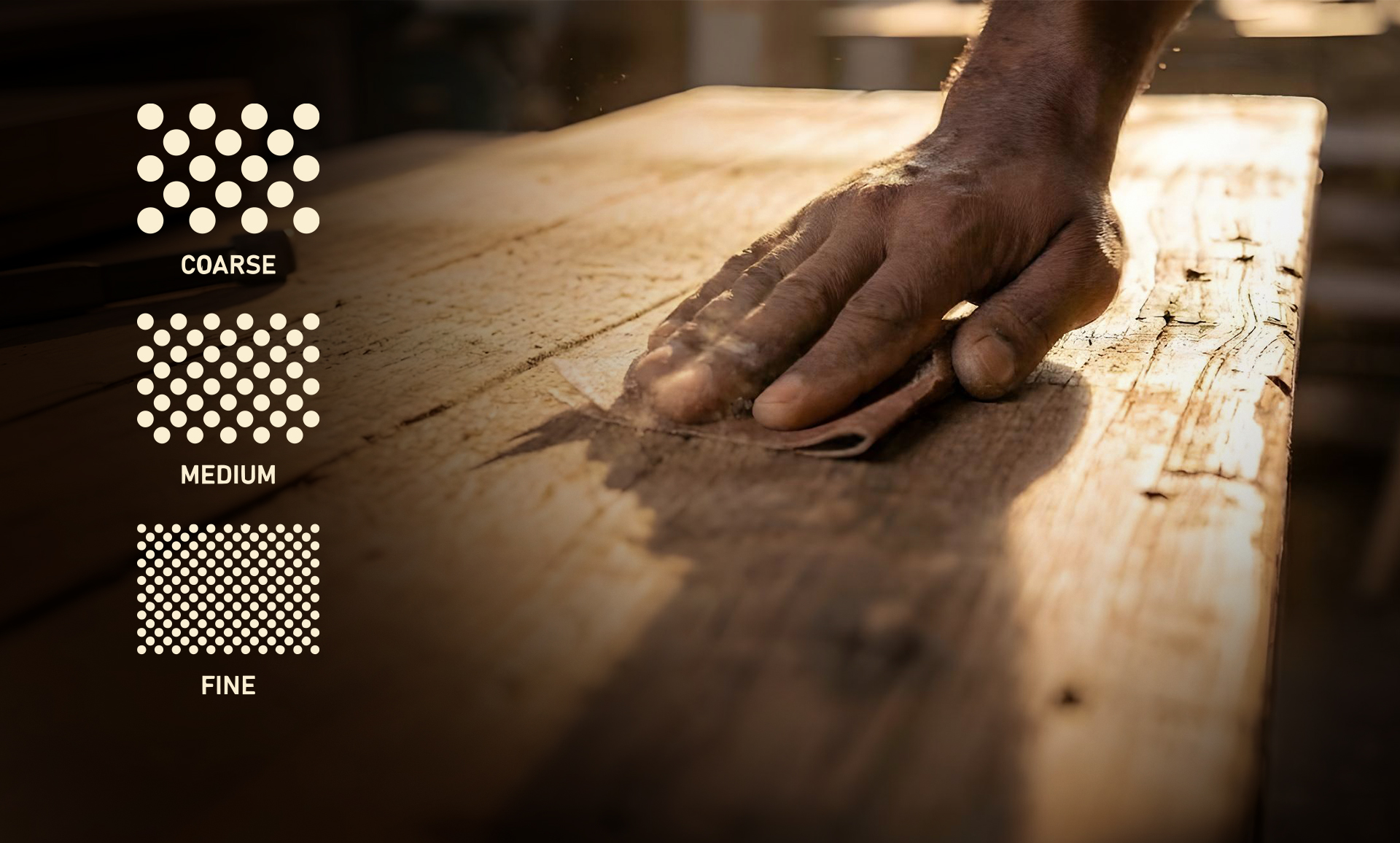
A practical guide to selecting the right sandpaper for wood furniture. It covers sanding stages, grit progression, abrasive materials, backing types and the CUMI products used in professional woodworking and furniture restoration.
Quick answer: For wood furniture, strip old paint or varnish with 60–80 grit, level the surface with 100–120, refine scratches with 150–180, and finish with 220–320 before staining or polishing. Aluminium oxide sandpaper suits most furniture work. Use cloth-backed rolls on curves and edges, and stearated paper for PU-coated or lacquered surfaces. Never skip more than one grit step.
Why Sandpaper Selection Matters in Furniture Refinishing
Sandpaper selection determines how efficiently old finishes are removed and how smooth the final wood surface becomes. With the correct abrasive, restorers can remove varnish, lacquer or paint while preserving the natural grain of the wood.
Furniture restoration is controlled material removal. Coarse abrasives remove finishes quickly but leave deeper scratches. Fine abrasives smooth the wood and prepare it for staining, polishing or painting.
That is why professional restorers follow a progressive sanding sequence, moving gradually from coarse to fine grit so that each stage removes the scratch pattern left by the one before it.
Typical Sanding Stages in Furniture Restoration
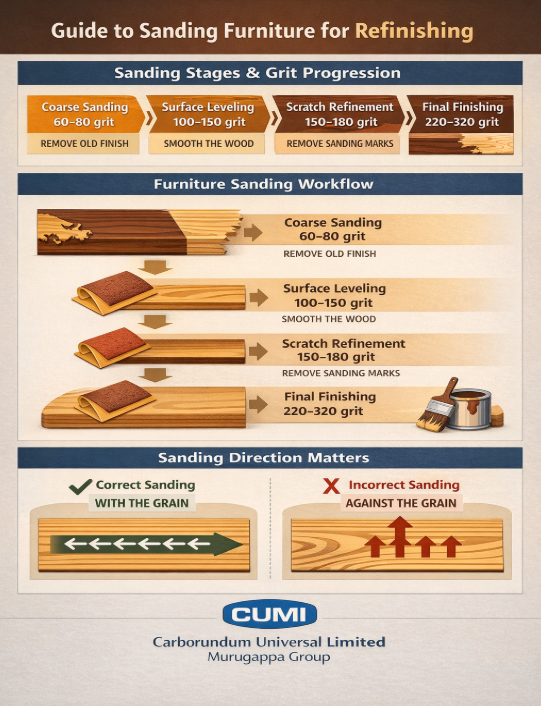
Furniture refinishing usually moves through four sanding stages, each refining the surface further.
1. Finish / Paint Removal: 60–80 grit Coarse abrasives strip old coatings such as paint, varnish or lacquer and expose the bare wood.
2. Surface Levelling: 100–120 grit Medium grit smooths the exposed wood and removes the deep marks left by coarse sanding.
3. Scratch Refinement: 150–180 grit This stage erases the levelling scratches and evens out the surface texture.
4. Final Surface Preparation: 220–320 grit Fine grit removes micro-scratches and prepares the wood for staining, polishing or painting. It is also the range to use when sanding between coats.
Recommended Sandpaper Grit Progression
| Grit Range | Purpose | Typical Application |
|---|---|---|
| 60–80 | Heavy coating removal | Removing paint, varnish, lacquer |
| 100–120 | Surface levelling | Preparing exposed wood |
| 150–180 | Scratch refinement | Removing marks from coarse sanding |
| 220–320 | Final finishing | Preparing wood for staining, painting or between coats |
Skipping grit levels leaves visible scratches in the final finish. Gradual grit progression keeps surface quality consistent.
Sandpaper Grit Chart for Furniture Refinishing
| Grit Band | Grit | What It Does on Furniture |
|---|---|---|
| Coarse | 60–80 | Strips paint, varnish and lacquer |
| Medium | 100–120 | Levels bare wood and removes stripping marks |
| Fine | 150–180 | Refines the scratch pattern before finishing |
| Extra Fine | 220–320 | Pre-stain preparation and sanding between coats |
For a complete reference across all grit grades and abrasive types, see our complete guide to sandpaper types.
Which CUMI Sandpaper to Use at Each Sanding Stage
Each refinishing stage calls for a different abrasive format. Here is how the CUMI range maps to typical furniture work.
| Stage | Grit | Hand Sanding | Orbital / Power Sanding |
|---|---|---|---|
| Stripping paint, varnish, lacquer | 60–80 | Concord NXT Cloth Roll, Ajax Cloth Roll | Concord Paper Hook & Loop Discs FP 567, Jawan 5-Hole Hook & Loop Disc |
| Levelling bare wood | 100–120 | Concord Roll, Ajax Sukha Plus Sheet | Hook & loop discs in a finer grit |
| Large flat panels (tabletops, doors) | 80–150 | — | CUMI ALO Polyester Belt YS549 |
| Final prep and between coats | 180–320 | Aluminium Oxide Stearated Paper Roll, Appu Sukha Sheet | Stearated hook & loop discs |
| Scuffing mouldings and carved detail | — | AJAX CX01 Hand Pads | — |
For high-volume furniture or modular production, CUMI’s technical team can trial custom grit combinations for your sanding line. Explore the full CUMI wood range or download the CUMI catalogue.
Common Abrasive Materials Used for Sanding Wood
Different abrasive materials for sanding wood affect cutting performance and sanding durability.
| Abrasive Material | Characteristics | Typical Use |
|---|---|---|
| Aluminium Oxide | Durable grains with an aggressive cut rate | General woodworking and furniture sanding |
| Silicon Carbide | Sharp cutting grains | Fine finishing, polishing, sanding between coats |
| Garnet | Natural abrasive producing a smooth finish | Traditional woodworking sanding |
Aluminium oxide is the most common choice for furniture refinishing because it balances durability with a consistent scratch pattern on wood.
Paper, Cloth or Film? Choosing the Right Backing for Furniture
The grain does the cutting, but the backing decides how the sheet behaves on curved legs, edges and power tools.
| Backing | Strengths | Best For | CUMI Example |
|---|---|---|---|
| Paper | Smooth, consistent scratch, low cost | Flat panels, final sanding, between coats | Stearated Paper Roll, FP 567 Hook & Loop Discs |
| Cloth | Flexible and tear-resistant | Curved legs, edges, turned parts, heavy stripping | Concord NXT Cloth Roll, Ajax Cloth Roll, Ajax Resin Cloth Roll |
| Film / Polyester | Moisture resistant, long life, uniform finish | Wet sanding of lacquer, belt sanders | ALO Polyester Belt YS549 |
Rule of thumb: use paper on anything flat and cloth on anything curved. For PU-coated surfaces, choose stearated paper with a semi-open coat, because it resists clogging and avoids burn marks.
Hand Sanding vs Power Sanding
Furniture restoration usually combines both approaches.
Power sanding Random orbital sanders are commonly used on large flat surfaces such as tabletops, cabinet panels and doors. They remove coatings efficiently while keeping the scratch pattern fairly uniform. For larger panels, a belt sander with a polyester-backed belt speeds up stock removal.
Hand sanding Hand sanding is typically used for:
- Edges and corners
- Intricate and contoured surfaces
- Curved furniture legs and arms
- Carved wood details
- Decorative mouldings
A sanding block helps distribute pressure evenly and keep flat surfaces flat. On curves, a flexible cloth-backed roll follows the shape without tearing.
Combining machine and hand sanding keeps the work efficient while preserving detailed furniture features.
Best Practices for Sanding Wood Furniture
Proper sanding practice improves both surface quality and finish durability.
- Progress gradually through grit levels instead of skipping stages
- Sand along the direction of the wood grain to prevent visible scratches
- Replace worn or clogged sandpaper regularly to keep it cutting cleanly
- Use sanding blocks to distribute pressure evenly
- Remove sanding dust completely before applying stain or paint
Consistent technique produces a smooth, uniform finish across the whole piece.
Common Mistakes to Avoid When Sanding Wood Furniture
- Jumping from 80 to 220. Fine grit can’t remove deep coarse scratches, and they show up the moment stain goes on. Move up one step at a time.
- Over-sanding edges and veneers. Edges and veneered tops thin out fast, especially under a power sander. Finish these by hand with light pressure.
- Using paper-backed sheets on curves. Paper tears and creases on turned legs and mouldings. Switch to a flexible cloth roll.
- Sanding across the grain. Cross-grain scratches stand out under stain. Always finish with the grain.
- Working with clogged sandpaper. A loaded sheet burnishes the wood instead of cutting it and can leave burn marks. Replace it, or use stearated paper on finishes.
- Leaving dust before staining. Leftover dust causes blotchy colour. Vacuum and wipe with a tack cloth before applying any coating.
Expert Insight from CUMI
From CUMI’s work with furniture, modular and flooring manufacturers across India, the most common finishing defect isn’t the wrong grit. It’s clogged abrasive during the final passes.
On PU-coated and lacquered furniture, we recommend a 120 → 180 → 240 → 320 sequence, switching to stearated paper after 180 grit so the sheet keeps cutting cleanly and doesn’t burn the coating. Good sanding preparation also improves how stains, oils and coatings penetrate the wood, which directly affects finish durability.
Frequently Asked Questions
1. What sandpaper number is best for wood furniture?
Wood furniture sanding usually starts with 60–80 grit to remove paint or varnish, moves to 100–120 grit for levelling and 150–180 grit for refinement, and finishes with 220–320 grit before staining, polishing or painting. Lower numbers remove material faster, while higher numbers give smoother finishes.
2. Which sandpaper is best for wood polishing?
For wood polishing, fine grit sandpaper between 180 and 320 grit is commonly used. These grits smooth the surface and remove minor scratches before you apply polish, stain, oil or a protective coating.
3. What grit sandpaper should be used to remove varnish from wood furniture?
Removing varnish generally starts with 60–80 grit sandpaper to strip the old finish. After that, refine the surface with 100–180 grit and finish with finer grits before polishing.
4. Is aluminium oxide or garnet sandpaper better for furniture refinishing?
Aluminium oxide sandpaper is usually preferred for furniture refinishing because it is more durable and lasts longer. Garnet sandpaper gives a smooth finish and is often used in traditional woodworking.
5. Can the same sandpaper be used for sanding and finishing wood?
No. Coarse sandpaper used for removing paint or levelling surfaces leaves scratches. Final finishing needs finer grit sandpaper to prepare the wood for staining, polishing or painting.
6. What is the best grit for sanding wood?
For most wood, start with 100–120 grit and finish with 180–220 grit. Drop to 60–80 grit only when stripping paint or varnish.
7. What sandpaper is best for curved furniture legs and mouldings?
Cloth-backed sandpaper rolls such as CUMI Concord NXT bend around curves without tearing. Use them in 100–180 grit for shaping, and finish by hand with the grain.
8. Which sandpaper should I use between coats of varnish or PU?
Use 240–320 grit stearated paper. The stearate coating stops the sheet clogging with soft finish, so it scuffs the surface evenly without burning through.
9. Is cloth or paper sandpaper better for furniture?
Paper gives a smoother, more consistent finish on flat surfaces. Cloth is stronger and more flexible, so it is better for stripping, edges and curved parts.
Need the right sandpaper for your furniture or workshop? CUMI makes sanding sheets, rolls, discs and belts for every stage of wood finishing. Call 1800 3000 1131, request a quote, or download the CUMI catalogue.
About the Author
This article was prepared by the CUMI Abrasives technical team, part of the Murugappa Group, a manufacturing conglomerate with more than a century of experience in materials engineering and industrial abrasives.
CUMI develops abrasive solutions used across industries, including metalworking, automotive manufacturing, woodworking and surface finishing. The insights in this article reflect practical knowledge of abrasive materials and finishing processes used in both industrial and workshop environments.
CUMI Abrasives – Carborundum Universal Limited Dare House Extension, 4th Floor, 234, NSC Bose Road, Chennai, Tamil Nadu 600001, India Customer Support: +91-8035120000 Sales: +91-7845121555