
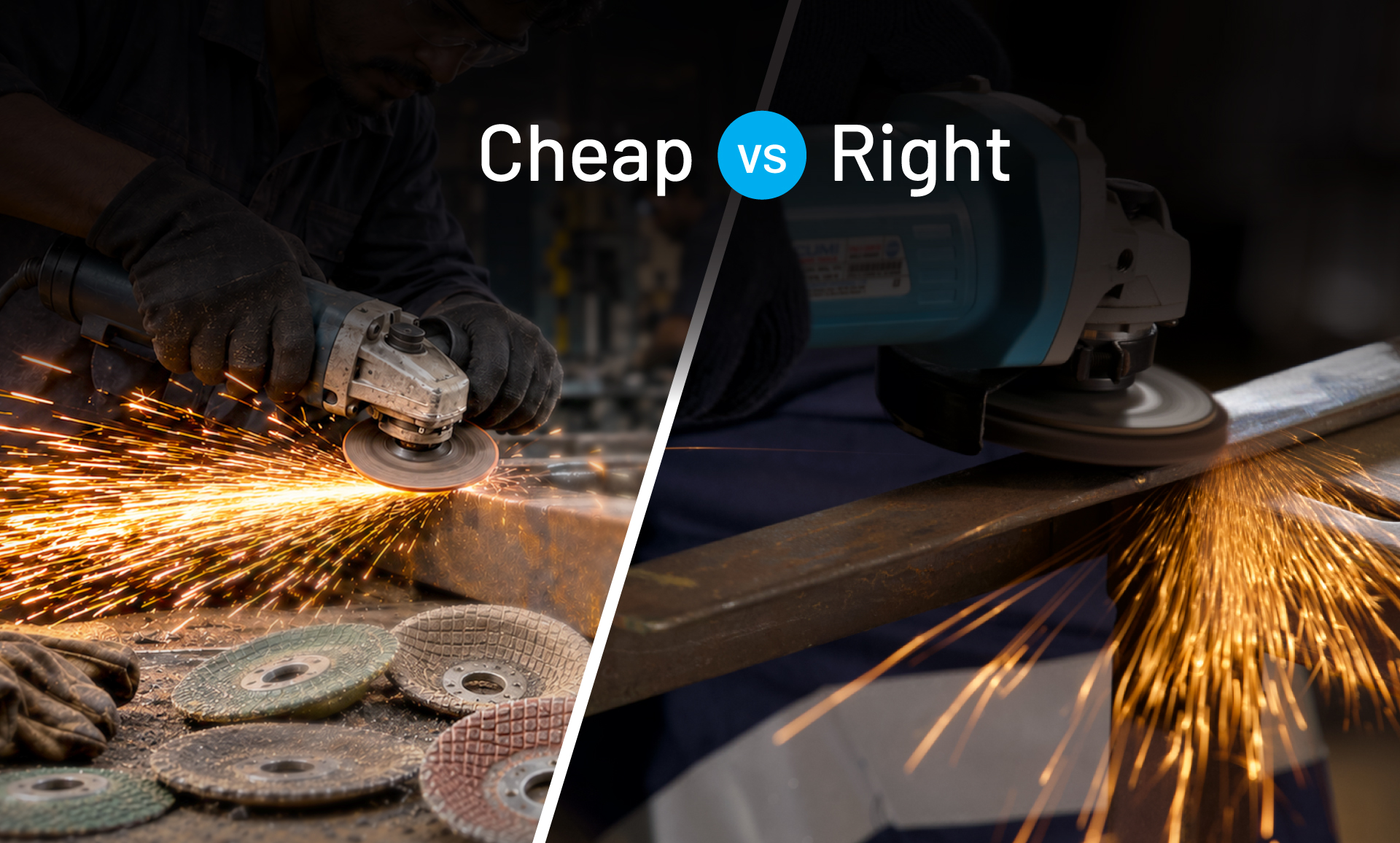
For small and mid-sized workshops across India — fabrication units, auto-repair garages, foundries, and steel fabricators — abrasives look like a small line item on the purchase register. In reality, grinding wheels, cutting discs, and coated abrasives directly affect three things that matter far more: finished-part quality, operator safety, and machine uptime. A wrong buying decision here doesn’t just waste a wheel; it wastes labour hours, damages workpieces, and in the worst cases, causes accidents.
Here are the five mistakes CUMI Abrasives sees most often in Indian workshops, and how to avoid them.
1. Buying on Price Alone, Not Cost-Per-Cut
The mistake: Choosing the cheapest wheel available per piece, without checking how many cuts or how much grinding it actually delivers before it wears out.
A wheel priced 20–30% lower often wears out two to three times faster, breaks down unevenly, or leaves a rougher finish that needs rework. Once you factor in the extra wheels consumed, the extra labour hours, and the machine time lost to more frequent wheel changes, the “cheap” option usually costs more per job.
What to do instead:
- Calculate cost-per-cut or cost-per-square-metre-ground, not cost-per-wheel.
- Track how many jobs a wheel completes before it needs replacing.
- Compare consistent-quality options against local alternatives over a full production cycle, not a single purchase.
In practice: a mid-sized fabrication unit switching from a lower-priced wheel to a consistent-quality one often sees wheel life extend from roughly 40–50 cuts to 90–100 cuts per piece — even at a 25–30% higher purchase price, the cost per cut typically comes down.
2. Mismatching Wheel Specification to Machine and Material
The mistake: Using a general-purpose wheel across every machine and every material — mild steel, stainless steel, castings, and hardened alloys — instead of matching the grain type, bond, and hardness grade to the actual job.
Different materials need different abrasive grain (aluminium oxide, silicon carbide, zirconia) and bond strength. A wheel built for mild steel will glaze over or burn stainless steel; a wheel meant for soft metal will wear too fast on hardened castings. This mismatch shows up as poor surface finish, excess heat, discoloured workpieces, and wheels that wear unevenly or crack.
What to do instead:
- Confirm the wheel’s recommended material group before buying, not after.
- For mixed-material workshops, keep separate, correctly specified wheels for each material category rather than one “do-it-all” wheel.
- Look for abrasive ranges that are built by material and application rather than one-size-fits-all — CUMI’s bonded and coated abrasives lines follow this approach.
3. Ignoring Safety Ratings and Certification Marks
The mistake: Buying wheels without checking the maximum operating speed (RPM) marked on the wheel against the actual machine speed, or skipping certification marks altogether.
This is the mistake with the highest real cost — not just in rupees, but in operator safety. A wheel run above its rated speed can burst during use. Uncertified or poorly manufactured wheels are far more likely to have inconsistent balance and structural weak points that aren’t visible until the wheel is already spinning on a machine.
What to do instead:
- Always match the wheel’s maximum RPM to the machine’s spindle speed — never the other way around.
- Buy only from manufacturers who mark wheels with recognised safety and quality certifications.
- Train operators to check the wheel specification label every time a new batch arrives, not just on the first order.
Grinding wheel safety in India is governed by IS 1991 (Safety Requirements for the Use, Care and Protection of Abrasive Grinding Wheels), which sets speed limits, guarding, and marking requirements — most reputable manufacturers mark compliance directly on the wheel.
4. Bulk-Buying Unbranded Abrasives for a Lower Unit Rate
The mistake: Ordering large quantities of unbranded or “local” abrasives to negotiate a lower per-piece rate, without checking batch-to-batch consistency.
Unbranded abrasives often vary from batch to batch — even within the same order — because manufacturing controls aren’t consistent. One batch performs fine; the next wears out fast, glazes early, or grinds unevenly. Workshops then spend time troubleshooting a “machine problem” that’s actually a wheel-quality problem, and operators lose trust in the process, sometimes over-compensating with heavier pressure that damages workpieces or machines.
What to do instead:
- Prioritise batch consistency over a marginally lower unit price.
- Buy from manufacturers with traceable, standardised production.
- Pilot a new supplier on a smaller order before committing to bulk quantities.
5. Using the Wrong Grit or Grain for the Job
The mistake: Using the same grit size for heavy stock removal, finishing, and polishing — instead of matching grit to the stage of work.
Coarse grit removes material fast but leaves a rough surface; fine grit gives a smooth finish but is inefficient for heavy grinding. Using one grit for every stage either wastes time (grinding too slow with fine grit) or wastes material and finish quality (finishing with a wheel meant for rough stock removal).
What to do instead:
- Stage your abrasive selection: coarse grit for stock removal, medium for shaping, fine for finishing.
- Keep a small reference chart at the workstation matching grit range to job type.
- For finishing and blending stages where a coated wheel would be too aggressive, non-woven abrasives are worth exploring.
Buy Right the First Time
Abrasive buying mistakes rarely show up on the day of purchase — they show up weeks later, in wasted wheels, reworked parts, and unplanned machine downtime. For Indian workshops working on tight margins, getting the specification, safety rating, and consistency right at the buying stage is one of the simplest ways to protect both cost and safety.
CUMI Abrasives has been manufacturing bonded, coated, and cutting abrasives in India since 1954, with product ranges built for specific materials and applications rather than one-size-fits-all use. Get in touch with the CUMI team to get the right specification for your workshop’s machines and materials, or browse the full range and download a product catalogue on the CUMI Abrasives products page.
Frequently Asked Questions
- What is the most common abrasive buying mistake in Indian workshops?
The most common mistake is choosing abrasives based on the lowest purchase price rather than the total cost per cut or per job, which often leads to higher overall spending due to faster wear and rework. - How do I know if a grinding wheel is safe for my machine?
Check that the wheel’s maximum rated RPM, printed on the wheel label, is equal to or higher than your machine’s spindle speed, and confirm the wheel carries a recognised safety certification mark. - Why do unbranded abrasive wheels perform inconsistently?
Unbranded or local abrasives often lack standardised manufacturing controls, so quality can vary between batches even within the same order, leading to unpredictable wear and finish quality. - Does using the wrong grit size actually cost a workshop money?
Yes. Using a grit that doesn’t match the job stage wastes either time (too fine for stock removal) or material and finish quality (too coarse for finishing), both of which add labour and material cost over time. - How can a workshop reduce abrasive-related costs without switching every supplier at once? Start by auditing cost-per-cut on your current wheels, checking RPM ratings against your machines, and piloting a certified, consistent-quality supplier on one product line before scaling up.
CUMI Abrasives – Carborundum Universal Limited
Dare House Extension, 4th Floor, 234, NSC Bose Road, Chennai, Tamil Nadu 600001, India
Customer Support: +91-8035120000
Sales: +91-7845121555
Email: [email protected]