

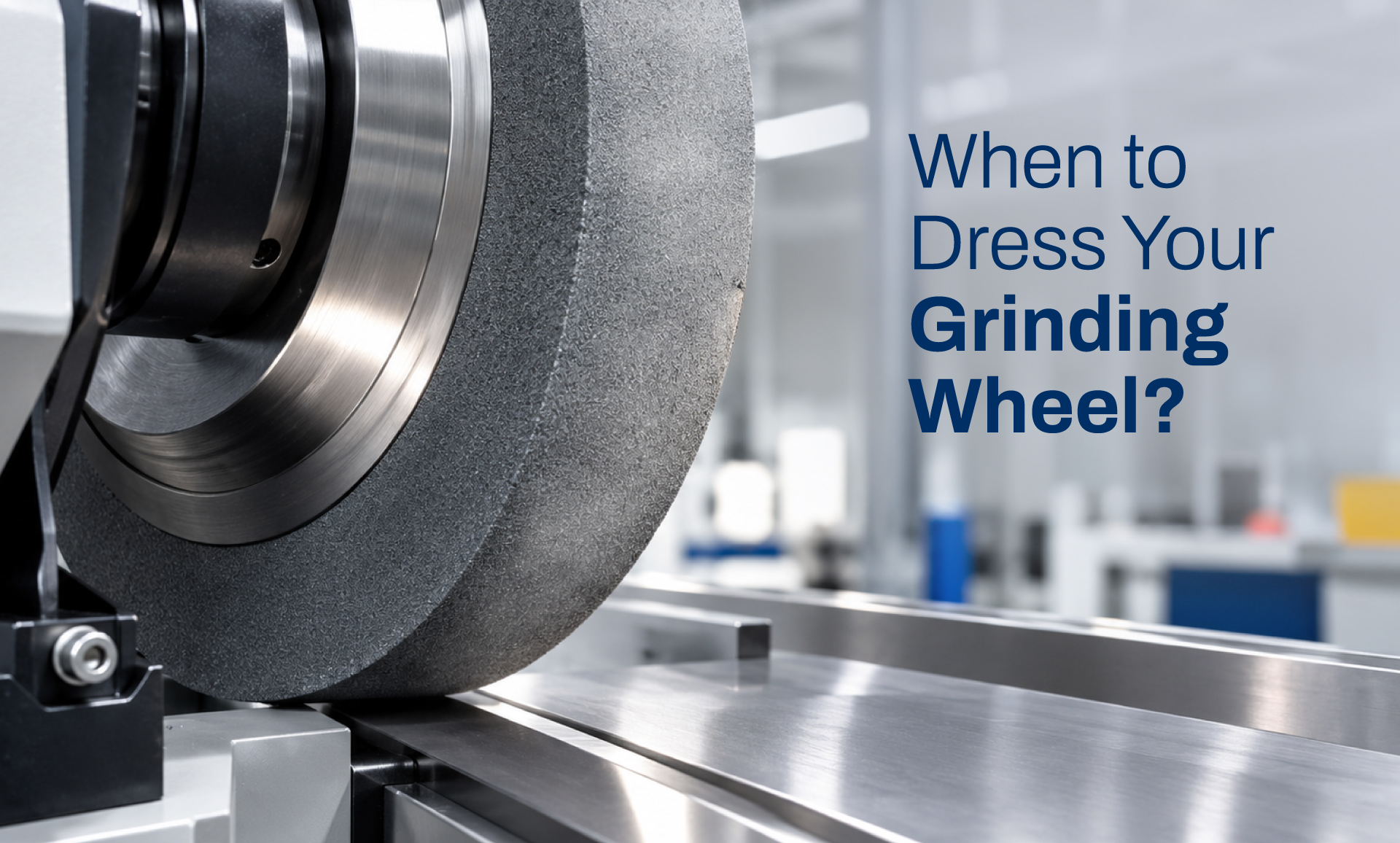
Quick answer: You should dress a grinding wheel when it starts cutting slower, burns the workpiece, makes more noise or vibration, looks shiny (glazed) or clogged with metal (loaded), or gives a poor surface finish. Dressing removes the dull, blocked layer of the wheel and exposes fresh, sharp abrasive grains so the wheel cuts cleanly again. Most operators dress at the start of a shift, after a wheel change, and whenever these warning signs show up.
What Is Grinding Wheel Dressing?
Grinding wheel dressing is the process of removing unwanted material from the surface of a grinding wheel to expose fresh abrasive grains and restore the required wheel shape.
During grinding, abrasive grains gradually become dull or loaded with workpiece material. The wheel may then produce more heat, require higher grinding pressure, or deliver a poor surface finish.Dressing helps the wheel regain its cutting ability.
In simple terms, dressing a grinding wheel cleans and sharpens the working surface of the wheel so that it can continue grinding effectively.
What Does “Dressing a Grinding Wheel” Mean?
Grinding wheel dressing is the process of cleaning and sharpening the working face of a wheel. Over time, the abrasive grains get dull and metal chips get stuck between them. A dressing tool, usually a diamond dresser, cuts away this tired outer layer. What’s left is a fresh, open surface with sharp grains ready to grind.
Think of it like sharpening a knife. A sharp wheel cuts with less pressure, less heat, and better finish.
At CUMI Abrasives, part of the Murugappa Group, we manufacture vitrified, resin, and rubber bonded grinding wheels along with diamond dressing tools. That’s why we see one simple truth on shop floors across India: most “bad wheel” complaints are actually “undressed wheel” problems.
Dressing vs Truing: What’s the Difference?
People often mix these two terms. Here’s the simple difference:
| Dressing | Truing | |
| What it does | Sharpens the wheel face and removes clogging | Makes the wheel perfectly round and concentric |
| Fixes | Glazing, loading, slow cutting, burning | Wobble, vibration, out-of-round running |
| When needed | Regularly during use | After mounting a new wheel or when the wheel runs unevenly |
| Result | Sharp, free-cutting surface | Correct shape and true running |
In practice, one pass with a diamond dresser often does both jobs at the same time.
7 Warning Signs Your Grinding Wheel Needs Dressing
Here are the most common signs a grinding wheel needs dressing. If you notice even one of them, it’s time to stop and check the wheel.
1. Burn Marks on the Workpiece
Blue, brown, or black burn marks mean the wheel is rubbing instead of cutting. Dull grains create friction and heat. This can damage the part’s hardness and lead to rejection.
2. The Wheel Looks Shiny or Glazed
A glazed grinding wheel has a smooth, shiny face. The grains have worn flat and are no longer sharp. A glazed wheel slides over the metal instead of biting into it.
3. Metal Stuck in the Wheel Face (Loading)
A loaded grinding wheel has metal particles packed into the gaps between grains. You’ll often see dark or grey patches on the wheel face. This is common when grinding soft metals like aluminium, brass, or mild steel.
4. Slow Cutting or Lower Stock Removal
If the same job takes longer than usual, or the operator has to push harder, the wheel has lost its cutting edge.
5. Poor Surface Finish
Chatter marks, lines, or a rough surface usually point to a dull or uneven wheel face.
6. More Noise and Vibration
A sharp wheel runs smooth. A dull or out-of-round wheel makes a squealing or harsh sound and causes vibration you can feel in the machine.
7. Size and Shape Problems
In precision work like cylindrical, centerless, or surface grinding, parts going out of tolerance is a clear sign the wheel profile needs dressing or truing.
How Often Should You Dress a Grinding Wheel?
There’s no single fixed number. How often you dress depends on the material, wheel type, and job. As a simple rule:
- Dress every new wheel after mounting, before the first job
- Dress at the start of each shift for precision grinding
- Dress whenever any warning sign above appears
- For production grinding, set a regular dressing interval based on parts ground, and adjust it from experience
Dressing too often wastes wheel life. Dressing too late causes burning and rejections. The goal is to find the right balance for your job.
How to Dress a Grinding Wheel: CUMI’s Simple Step-by-Step Guide
Follow these basic steps for safe and effective grinding wheel dressing:
- Check safety first. Wear eye protection and make sure the wheel guard is in place. Never exceed the wheel’s rated speed.
- Pick the right dresser. Use a single-point diamond dresser for general and precision work, a multi-point or cluster diamond dresser for larger wheels, and a star (mechanical) dresser for rough bench grinding.
- Set the dresser angle. Hold a single-point diamond at about 10–15 degrees, tilted in the direction of wheel rotation. Rotate the diamond slightly from time to time so it stays sharp.
- Run the wheel at operating speed. Let it spin normally before you start.
- Take light passes. Feed the dresser in small depths, usually just a few hundredths of a millimetre per pass. Heavy cuts waste the wheel and wear the diamond.
- Move across at a steady speed. A slow traverse gives a finer finish. A faster traverse gives a more open, aggressive wheel face for heavy stock removal.
- Use coolant if your machine has it. This protects the diamond from overheating.
- Stop when the face is clean and sharp. Look for an even, dull-matte surface with no shiny or loaded spots.
Tip: Never let a diamond dresser touch the wheel when it’s stationary, and never start a dressing pass in the middle of the wheel face.
Common Grinding Wheel Dressing Mistakes to Avoid
- Taking deep cuts to “save time”
- Using a worn, rounded diamond
- Dressing without coolant on precision machines
- Skipping dressing after mounting a new wheel
- Choosing the wrong wheel grade, which makes the wheel glaze or load too fast
If your wheel glazes or loads again and again even after dressing, the problem may be the wheel specification itself, not the dressing. A wheel that’s too hard often glazes. A wheel with the wrong grain or structure often loads.
Why Choose CUMI Grinding Wheels and Dressing Tools?
CUMI has been making abrasives in India for decades as part of the Murugappa Group. Our range includes vitrified grinding wheels, resin bonded wheels, centerless grinding wheels, and diamond dressing tools built for automotive, railways, foundry, and fabrication shops.
Our application support team can help you pick the right wheel grade and set the right dressing practice for your machine, so you get longer wheel life and fewer rejections.
Frequently Asked Questions
1.How do I know when my grinding wheel needs dressing?
Look for burn marks on the part, a shiny or clogged wheel face, slow cutting, poor finish, or extra noise and vibration. Any of these means the wheel needs dressing.
2.What happens if you don’t dress a grinding wheel?
The wheel gets dull and clogged. It starts rubbing instead of cutting, which causes heat, burn marks, poor finish, more power use, and more rejected parts.
3.What tool is used to dress a grinding wheel?
The most common tool is a diamond dresser, either single-point or multi-point. Star dressers and dressing sticks are used for bench and rough grinding.
4.Is dressing the same as truing a grinding wheel?
No. Dressing sharpens and cleans the wheel face. Truing makes the wheel round and concentric. One diamond dresser pass often does both.
5.Why does my grinding wheel keep glazing?
A wheel usually keeps glazing because it’s too hard for the job, the speed is too high, or the feed is too light. Try a softer grade or ask CUMI’s technical team for the right specification.
6.Can I dress a resin bonded wheel?
Yes. Resin bonded wheels can be dressed, though they’re often dressed with abrasive sticks or rotary dressers depending on the application.
Need Help Choosing the Right Wheel or Dresser?
Talk to CUMI’s application experts for the right grinding wheel and dressing solution for your shop. Call our toll-free number 1800 3000 1131 or download the full product catalogue.