
Quick Summary: Prevent scratches on stainless steel by following a progressive grit sequence, selecting abrasives based on surface geometry, using controlled pressure, and keeping polishing tools free from cross-contamination.
Why Does Stainless Steel Scratch During Polishing?
Scratches during stainless steel polishing can occur when the abrasive is too aggressive for the finishing stage, the wrong grit is selected, excessive pressure is applied, or abrasive particles from a previous operation remain on the surface.
Stainless steel also requires careful control of surface consistency. A finer abrasive cannot always remove deeper scratches created by an earlier coarse operation. Following a controlled progression from material removal to intermediate finishing and final polishing helps achieve a more uniform surface.
Another important consideration is cross-contamination. Using the same abrasive tool on carbon steel and stainless steel can transfer free iron particles onto the stainless steel surface. These contaminants can contribute to surface staining, corrosion and unwanted marks.
The objective should be controlled material removal and uniform surface refinement, rather than applying maximum pressure to achieve a faster finish.
How to Prevent Scratches When Polishing Stainless Steel
1. Follow a Progressive Grit Sequence
Grit selection is one of the most important factors when polishing stainless steel.
Coarser abrasives are useful for defect removal, deburring and material removal, while progressively finer abrasives are better suited to surface refinement and finishing. Moving directly from a coarse abrasive to a very fine abrasive can leave deeper marks from the previous operation.
A practical finishing sequence can be:
Deburring → Material Removal → Scratch Refinement → Fine Finishing → Final Polishing
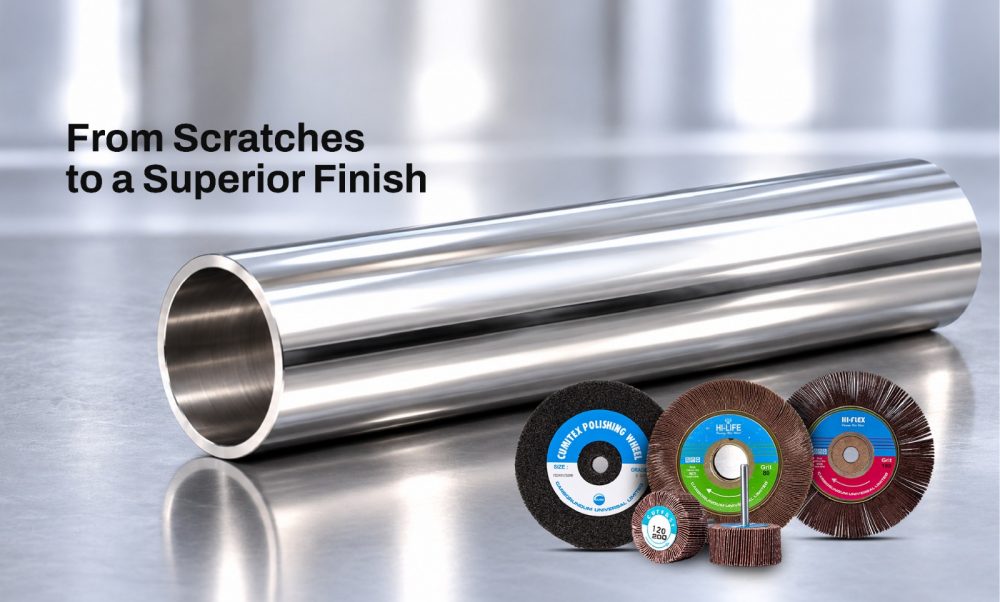
CUMI’s mop range provides multiple grit options for different finishing stages. HI-LIFE Bore Mops are available in grits from 60 to 600 and use premium aluminium oxide grains with densely packed flaps for finishing stainless steel, mild steel and alloys.
Using the appropriate grit at each stage helps ensure that scratches from earlier operations are progressively refined rather than carried into the final finish.
2. Choose the Right Mop Wheel for the Surface
The geometry of the stainless steel component also affects abrasive selection. A wheel suitable for an external surface may not provide the same control when working inside a pipe, vessel or other difficult-to-reach area.
HI-LIFE Bore Mops are designed for ID and OD polishing of pipes, vessels and fabrications. Their densely packed abrasive flaps and larger flange are designed to provide stability, consistent abrasive exposure and a refined finish.
For applications involving curves, contours or surfaces where greater flexibility is required, HI-FLEX Bore Mops use specially treated cotton backing and premium aluminium oxide grain. Their flexible construction allows the mop to conform more effectively to different contours.
3. Avoid Excessive Polishing Pressure
Applying more pressure does not necessarily produce a better stainless steel finish. Excessive force can create inconsistent abrasive contact, accelerate material removal and make it more difficult to maintain a uniform surface.
Allow the abrasive to perform the cutting action. Maintain controlled movement and consistent contact instead of holding the wheel aggressively against one area.
This becomes particularly important during fine finishing, where the objective is to refine the existing surface rather than remove large amounts of material.
4. Use Dedicated Tools to Avoid Cross-Contamination
Pro Tip: Use polishing and finishing tools dedicated exclusively to stainless steel whenever possible. Abrasive tools previously used on carbon or mild steel can transfer free iron particles onto stainless steel, potentially causing contamination, surface staining and premature corrosion.
Keep abrasives separated according to the material being processed. Avoid using a tool that has already been used on carbon steel for a stainless steel finishing operation simply because the abrasive still appears usable.
Tool separation is a simple but important part of maintaining a clean and consistent stainless steel surface.
CUMI Product Selector for Stainless Steel Polishing
| PRODUCT LINE | PRIMARY BEST USE CASE | KEY FEATURE | AVAILABLE GRITS |
|---|---|---|---|
| HI-LIFE Bore Mops | ID & OD finishing of pipes, vessels and fabrications | Densely packed flaps for consistent finishing and long life | 60–600 |
| HI-FLEX Bore Mops | Contours, curves and flexible geometries | Specially treated cotton backing for greater flexibility | Variety |
| CUTFAST Spindle Mops | Hard-to-reach areas, deburring and finishing | Reinforced spindle for machine stability | 36–600 |
| CUMITEX Polishing Wheels | Intermediate to final surface blending and polishing | Silicon carbide and nylon-fibre construction with anti-clogging properties | Fine / Polishing |
Step-by-Step: Polishing Stainless Steel Pipes Without Scratching
When polishing stainless steel pipes, begin by identifying whether the application involves the inside diameter (ID), outside diameter (OD), or both.
Step 1: Inspect the Surface
Identify existing scratches, burrs, weld marks, oxidation or other surface imperfections. This helps determine the appropriate starting grit.
Step 2: Start With the Appropriate Grit
Use a coarser abrasive only when necessary for defect removal or material removal. Avoid starting with an unnecessarily aggressive grit, as deeper abrasive marks can increase the amount of finishing required later.
Step 3: Progress Through the Grits
Move progressively toward finer abrasives as the surface improves. Do not skip too many stages when deep scratches or coarse abrasive marks are present.
Step 4: Select the Mop According to Geometry
For ID and OD finishing of pipes, vessels and fabrications, HI-LIFE Bore Mops provide a suitable configuration.
Where flexibility and contour conformity are important, HI-FLEX Bore Mops can be considered.
For difficult-to-reach areas and deburring operations, CUTFAST Spindle Mops provide a configuration suited to machine sanding and finishing.
Step 5: Maintain Controlled Pressure
Keep the abrasive moving consistently across the surface. Avoid concentrating pressure on one area, particularly during fine finishing.
Step 6: Use a Suitable Finishing Wheel
For intermediate to final surface refinement, CUMITEX Polishing Wheels provide an additional option for sanding, blending, cleaning, deburring, decorative finishing and polishing.
Step 7: Inspect the Final Surface
Check the surface under suitable lighting to identify remaining scratches, inconsistent finishing or contamination. If deeper marks remain, return to the appropriate intermediate grit rather than relying on excessive pressure with a fine abrasive.
Which CUMI Abrasive Is Suitable for Stainless Steel Polishing?
The right CUMI abrasive depends on the component geometry, finishing stage and required surface result.
HI-LIFE Bore Mops are suited to ID and OD finishing of stainless steel pipes, vessels and fabrications. Their densely packed flaps are designed for consistent finishing and longer wheel life, with grit options extending from 60 to 600.
HI-FLEX Bore Mops are suitable when flexibility and contour conformity are important. Their specially treated cotton backing helps the mop conform to curved and contoured surfaces.
CUTFAST Spindle Mops are designed for deburring, cleaning, sanding and finishing, particularly in difficult-to-reach areas such as pipes, cylinders and moulds. Their available grit range from 36 to 600 supports different stages of grinding and finishing.
For intermediate to final surface refinement, CUMITEX Polishing Wheels provide another option. CUMI describes CUMITEX as a silicon-carbide and nylon-fibre polishing wheel for sanding, blending, cleaning, deburring, decorative finishing and polishing. Its anti-clogging structure is designed to support controlled abrasive action and reduce excessive material removal.
Frequently Asked Questions
What abrasive is best for polishing stainless steel?
The best abrasive depends on the finishing stage, surface condition and required finish. CUMI offers aluminium oxide mop products for stainless steel grinding, sanding and finishing, while CUMITEX uses silicon carbide and nylon fibre for surface blending and polishing applications.
How do you prevent scratches during stainless steel polishing?
Use the appropriate starting grit, follow a progressive grit sequence, avoid excessive pressure, select an abrasive based on the surface geometry and prevent cross-contamination from tools previously used on other metals.
Which CUMI mop is suitable for stainless steel pipes?
HI-LIFE Bore Mops are designed for ID and OD finishing of pipes, vessels and fabrications. HI-FLEX Bore Mops are another option where greater flexibility and contour conformity are required.
Which CUMI product is suitable for difficult-to-reach areas?
CUTFAST Spindle Mops are designed for deburring, cleaning and finishing in difficult-to-reach areas such as pipes, cylinders and moulds.
Can the same polishing wheel be used on stainless steel and carbon steel?
It is better to use dedicated abrasive tools for stainless steel. Sharing tools between carbon steel and stainless steel can transfer free iron particles and other contaminants onto the stainless steel surface.
What is the best way to achieve a uniform stainless steel finish?
Use a controlled grit progression, maintain consistent pressure, select the abrasive according to the surface geometry and use dedicated tools to minimise contamination. CUMI’s abrasive range includes solutions for grinding, sanding, blending, polishing and finishing stainless steel components.
Ready to Improve Your Stainless Steel Finishing Process?
Choose the abrasive according to your material, surface condition, component geometry and required finish. CUMI’s range of bore mops, spindle mops and polishing wheels provides solutions for different stages of stainless steel surface finishing.
Explore CUMI’s full abrasives range or contact CUMI’s application experts for guidance on selecting the right abrasive and grit for your stainless steel polishing application.