
Introduction
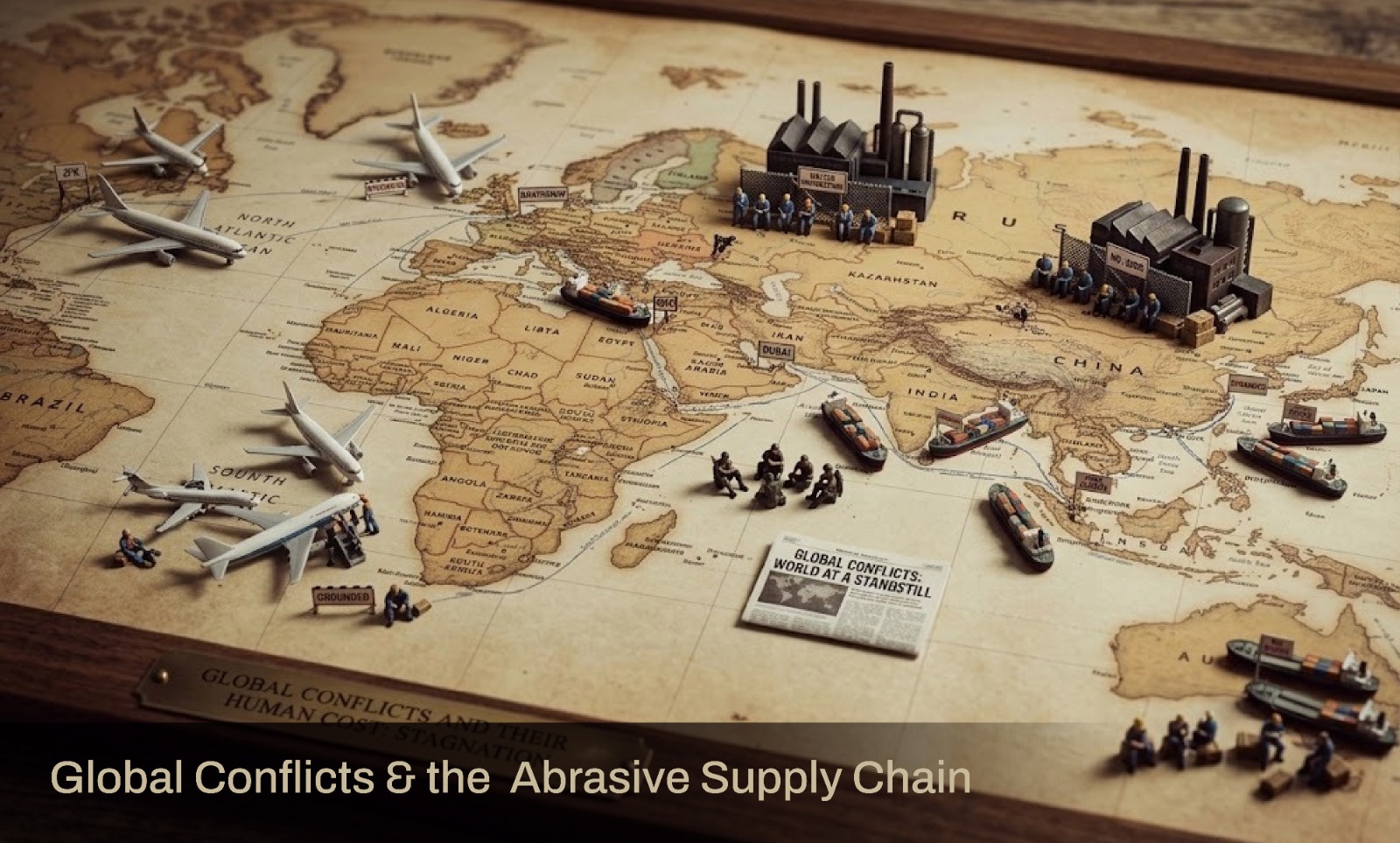
Global conflicts rarely remain confined to the countries directly involved. Their effects can spread across international trade, shipping routes, energy markets, raw-material sourcing and manufacturing operations.
For the abrasive industry, these disruptions can have a wider impact because abrasive products are an important part of manufacturing processes across industries such as automotive, steel, aerospace, bearings, metal fabrication, foundry and forging.
A disruption in the supply of raw materials or transportation can therefore create a chain reaction:
Global conflict → trade disruption → raw-material/logistics pressure → abrasive supply-chain disruption → manufacturing impact
Understanding these connections is becoming increasingly important for abrasive manufacturers as well as industrial buyers.
Quick answer: Global conflicts affect the abrasive industry in four main ways:
- Raw material shortages
- Shipping delays
- Energy price swings
- Trade restrictions
Together these raise costs and lengthen lead times for grinding wheels, cutting wheels and coated abrasives. Buyers reduce the risk by choosing suppliers with in-house raw materials, plants in more than one country, local stock and strong technical support.
CUMI, part of the Murugappa Group, is a “mines-to-market” abrasive manufacturer. Its operations cover mining, power generation, fusion, manufacturing and distribution, which helps it keep supply steady for customers in India and abroad.
How Global Conflicts Disrupt Industrial Supply Chains
Modern manufacturing depends on interconnected international supply chains. A company may source raw materials from one region, manufacture products in another and distribute them to customers across several countries.
Global conflicts can disrupt this model in several ways.
1. Raw Material Supply Disruptions
Abrasive manufacturing depends on key inputs such as abrasive grains, bonds, resin and mesh. CUMI’s bonded abrasive value chain, for example, identifies these as key inputs for its manufacturing operations.
When conflicts affect mining, processing, exports or international trade, the availability and cost of these inputs can change.
This can result in:
- Longer procurement cycles
- Increased raw-material costs
- Difficulty maintaining inventory
- Greater supplier dependency
- Production-planning challenges
2. Transportation and Shipping Disruptions
Conflicts can affect shipping lanes, ports, air freight and land transportation.
Even when raw materials remain available, getting them to the manufacturing facility or delivering finished abrasive products to customers can become more complicated.
This can lead to:
Longer routes → higher freight costs → longer delivery times → increased inventory requirements
3. Energy Price Volatility
Energy is an important factor in industrial manufacturing. Geopolitical instability can affect fuel and electricity markets, increasing operating costs for manufacturers.
For abrasive manufacturers, this can influence the cost of production, transportation and distribution.
4. Trade Restrictions and Regulatory Changes
Conflicts can also result in sanctions, export restrictions, import controls and changes in trade policies.
These measures can make certain markets more difficult to serve and may force manufacturers to reconsider sourcing and distribution strategies.
What Does This Mean for the Abrasive Industry?
The abrasive industry is closely connected to the wider manufacturing ecosystem.
Grinding wheels, cutting wheels and other abrasive products are used in processes where manufacturers need to cut, grind, finish, sharpen or prepare materials.
CUMI serves a wide range of industries, including automotive, aerospace, bearing, steel, foundry & forging, transmission, renewable energy and metalworking.
Therefore, supply-chain disruptions can affect the abrasive industry in two directions:
Upstream: Difficulty sourcing materials and manufacturing inputs.
Downstream: Changes in demand from industries that use abrasive products.
How Global Conflicts Affect Grinding Wheel Manufacturing
Grinding wheels are not simply generic consumable products. Different applications require specific combinations of abrasive grain, grit, hardness, bond and wheel specifications.
CUMI’s industrial range includes grinding wheels designed for different materials and operations, including cylindrical and centreless grinding applications.
When supply-chain conditions become uncertain, manufacturers may face challenges in:
- Sourcing abrasive grains and other inputs
- Maintaining consistent production
- Managing product inventory
- Meeting customer-specific requirements
- Maintaining delivery schedules
- Controlling manufacturing costs
For industrial customers, this can become particularly important when abrasive products are part of a continuous production process.
How Supply Chain Disruptions Affect Industries That Depend on Abrasives
The impact does not stop with abrasive manufacturers.
Automotive Manufacturing
Automotive and auto-component manufacturers use grinding and finishing processes for various precision components.
If automotive production is affected by shortages, transportation problems or changing demand, abrasive requirements can also change.
Bearing Manufacturing
Precision grinding is an essential part of bearing manufacturing.
A disruption in abrasive availability can potentially affect production schedules where grinding operations are critical to component quality and dimensional accuracy.
Steel and Metal Fabrication
Steel and fabrication operations rely heavily on cutting and grinding products for material preparation, weld preparation, surface finishing and other applications.
CUMI provides abrasive solutions for metalworking and steel-related applications.
Aerospace Manufacturing
Aerospace manufacturing requires high levels of precision and process consistency. Abrasive products used in these applications therefore need to be available with appropriate specifications and performance characteristics.
Foundry and Forging
Foundries and forging operations use abrasives for material removal, fettling, finishing and other processes.
CUMI specifically identifies foundry and forging among the industries it serves.
India’s Role in the Global Abrasive Supply Chain
For many years, global abrasive buyers depended heavily on a small number of countries for both abrasive grains and finished products. China in particular produces a large share of the world’s fused alumina and silicon carbide. When conflicts, sanctions or shipping disruptions hit a concentrated supply base, buyers everywhere feel it.
That’s why more distributors and OEMs are now adding a second or third source region, often called a “China +1” strategy. India has become a strong option for several reasons:
- A mature abrasives industry. India has made bonded and coated abrasives for over seven decades. CUMI itself began in 1954.
- Domestic raw materials. India has bauxite, a key raw material for fused alumina, and local electrominerals production. That reduces dependence on imported grain.
- Wide industrial demand at home. A large domestic market across automotive, steel, bearings, construction and fabrication keeps Indian plants running at scale, which supports steady supply for export customers.
- Government support for manufacturing. Make in India and production-linked incentive (PLI) schemes are expanding India’s manufacturing base and supplier ecosystem.
- Location and shipping access. India sits between the Middle East, Africa, Southeast Asia and Europe, with established sea routes to each.
What this means for international buyers: Distributors and OEMs in Africa, the Middle East, Europe, Australia and Southeast Asia can use an Indian manufacturer to spread supply risk without giving up product range or quality standards.
CUMI already supplies markets including the Middle East, Africa, Europe, the USA, Southeast Asia, Japan, Korea and Australia. International distributors can explore partnership options on the CUMI Partnership page.
How CUMI Builds Supply Chain Resilience
Procurement managers who weigh supply risk need to know how much of a supplier’s chain the supplier actually controls. Here’s how CUMI is set up:
- Mines-to-market integration
CUMI describes itself as a mines-to-market company. Its operations span mining, power generation, fusion, manufacturing, marketing and distribution. The group runs its own bauxite mines, so it isn’t relying on spot-market purchases for that key raw material. - In-house abrasive grains (electrominerals)
CUMI’s Electrominerals business produces abrasive grains such as brown fused alumina, white fused alumina and silicon carbide. Making the grain in-house gives CUMI more control over grain quality and availability than manufacturers that buy all their grain on the open market. - Captive power generation
Fusing abrasive grain uses a lot of energy. CUMI’s own power generation, including hydel power, helps cushion the energy price swings that often follow geopolitical shocks. - Multiple manufacturing locations
CUMI makes bonded abrasives in Tiruvottiyur, Maraimalai Nagar, Hosur, Uttarakhand, Russia and Germany. Coated abrasives come from Maraimalai Nagar, Sriperumbudur, Kolkata, Russia and Germany. Several plants across regions mean a disruption in one place doesn’t stop supply altogether. - Wide distribution and technical support
CUMI reaches customers through wholesalers, industrial distributors, OEMs and MSME sub-dealers, with application engineers who can recommend equivalent specifications when a product is hard to get.
| Supply Risk | How It Typically Hits Buyers | How CUMI’s Setup Helps |
| Abrasive grain shortage | Delays and price hikes on wheels and belts | In-house electrominerals (fused alumina, silicon carbide) |
| Raw material export restrictions | Sudden input shortages | Own bauxite mines |
| Energy price spikes | Higher manufacturing costs passed on to buyers | Captive power generation |
| Disruption at a single plant or region | Supply stops completely | Plants in India, Russia and Germany |
| Product unavailable | Line stoppage while a substitute is qualified | Technical team recommends equivalent specifications |
How Abrasive Manufacturers Can Support Customers During Disruptions
Abrasive manufacturers can play a larger role than simply supplying products.
Technical teams can help customers:
- Select suitable abrasive specifications
- Identify alternative products
- Optimize grinding parameters
- Improve wheel life
- Reduce dressing frequency
- Improve productivity
- Reduce unnecessary abrasive consumption
This becomes particularly valuable when customers need to maintain production despite changing supply conditions.
CUMI highlights application-specific engineering and technical support as part of its abrasive offering, alongside products designed for different industrial requirements.
Buyer’s Checklist: How to Reduce Abrasive Supply Chain Risk
Procurement and plant teams can use this checklist to review their current abrasive suppliers and plan for disruption.
Questions to Ask Your Abrasive Supplier
| Area | What to Ask | Why It Matters |
| Raw materials | Do you make your own abrasive grain, or buy it? Where does it come from? | Suppliers with their own grain are less exposed to grain shortages and price spikes. |
| Manufacturing footprint | How many plants make my products, and in which countries? | More than one location means a single disruption won’t stop supply. |
| Inventory policy | How much finished stock do you hold for my SKUs? Do you hold local or regional stock? | Buffer stock covers you during shipping delays. |
| Lead times | What are your normal and worst-case lead times? Will you commit to them in writing? | Realistic lead times let you plan safety stock properly. |
| Price stability | How do you handle raw material and energy cost increases? Is there a price review clause? | Avoids surprise price hikes during a crisis. |
| Quality consistency | Will specifications stay the same if you switch raw material sources? How do you control batch-to-batch variation? | A substitute grain can change wheel performance on your line. |
| Alternatives | If my product is unavailable, which equivalent can you supply, and how fast can it be qualified? | Pre-approved alternatives prevent line stoppages. |
| Technical support | Do you have application engineers who can visit my plant? | Fast support during a product switch protects quality and output. |
| Certifications | Are your plants ISO 9001 and ISO 14001 certified? Do your wheels meet the safety standards my customers need (e.g. EN 12413)? | Compliance should not slip when supply is under pressure. |
Actions to Take Inside Your Own Plant
- List your critical abrasives. Identify the wheels, discs and belts whose shortage would stop a production line.
- Hold safety stock for critical items. Base the amount on your supplier’s worst-case lead time, not the normal one.
- Qualify a second source in advance. Trial and approve backup specifications before a crisis, not during one.
- Standardise where you can. Fewer SKUs make stock easier to hold and suppliers easier to switch.
- Share forecasts with your supplier. Rolling demand forecasts help suppliers plan production and stock for you.
- Track cost per component, not cost per wheel. A longer-lasting abrasive reduces how often you need to reorder, which lowers your exposure to shortages.
- Review suppliers every year. Supply chains change, so revisit this checklist annually.
Download the CUMI product catalogue to map equivalent specifications across your critical abrasives.
Conclusion
Global conflicts can affect the abrasive industry indirectly through raw-material availability, transportation, energy costs, trade restrictions and changes in industrial demand.
Because abrasives are used across critical manufacturing sectors, disruptions in abrasive supply can have implications beyond the abrasive industry itself.
The long-term solution is not simply to hold more inventory. It is to build a more resilient industrial supply chain supported by diversified sourcing, reliable manufacturing, effective distribution and strong technical partnerships.
For abrasive manufacturers and industrial buyers alike, resilience will increasingly become an important part of maintaining productivity and business continuity in an unpredictable global environment.
CUMI’s integrated approach to abrasives, spanning materials, manufacturing, distribution and application support, provides a strong example of how an abrasive manufacturer can build capabilities across the value chain.
Secure Your Abrasive Supply with CUMI
CUMI (Carborundum Universal), part of the 124-year-old Murugappa Group, has made abrasives since 1954. With in-house raw materials, plants in India, Russia and Germany, and a nationwide distribution network, CUMI helps manufacturers and distributors keep production running through uncertain times.
CUMI (Carborundum Universal Limited), part of the 124-year-old Murugappa Group, has been manufacturing high-quality abrasives since 1954. With in-house raw material capabilities, manufacturing facilities in India, Russia, and Germany, and an extensive nationwide distribution network, CUMI delivers reliable abrasive solutions that help manufacturers and distributors maintain operational efficiency and ensure uninterrupted production.
- Explore the range: Bonded Abrasives | Coated Abrasives | Cutting & Grinding
- Download the catalogue: CUMI Product Catalogs
- International distributors and OEMs: Explore partnership with CUMI
- Talk to our team: Call 1800 3000 1131 (toll-free) or contact us to discuss supply planning for your critical abrasives.
Frequently Asked Questions
1. How do global conflicts affect the abrasive industry?
Global conflicts can affect the abrasive industry through raw-material shortages, transportation disruptions, energy-price changes, trade restrictions and fluctuations in industrial demand.
2. Do global conflicts affect grinding wheel prices?
They can. Changes in raw-material, energy, transportation and manufacturing costs can contribute to changes in the overall cost of producing and distributing grinding wheels.
3. How do supply-chain disruptions affect industrial abrasive buyers?
Industrial buyers may experience longer lead times, product-availability challenges, higher costs and greater uncertainty when planning production and inventory.
4. Which industries are most affected by abrasive supply-chain disruptions?
Industries that rely heavily on cutting, grinding and finishing processes—including automotive, bearings, steel, aerospace, metal fabrication, foundry and forging—can be affected when abrasive supply becomes disrupted. CUMI serves these and several other industrial sectors.
5. How can manufacturers reduce abrasive supply-chain risks?
Manufacturers can reduce risk through supplier diversification, strategic inventory planning, alternative sourcing, demand forecasting, regional supply capabilities and strong technical partnerships.
6. Why is supplier diversification important for abrasive manufacturers?
Supplier diversification reduces dependence on a single source of raw materials, manufacturing location or transportation route, giving companies greater flexibility during disruptions.
7. Can abrasive product performance help reduce supply-chain risks?
Yes. Abrasives that deliver longer life, consistent performance and fewer dressing requirements can help manufacturers improve productivity and reduce the frequency of abrasive replacement.
8. Why should industrial buyers consider technical support when selecting an abrasive supplier?
Technical support can help manufacturers select the appropriate abrasive specification, optimize grinding processes and identify suitable alternatives when production requirements or supply conditions change.
9. How important is supply-chain resilience for the future of the abrasive industry?
It is increasingly important because abrasive manufacturers operate within interconnected global supply chains. Building resilience can help companies maintain product availability and support customers during periods of market or geopolitical uncertainty.
10. How does CUMI support industrial customers?
CUMI provides abrasive products and application-focused support across multiple industrial sectors. Its portfolio includes bonded and coated abrasives, cutting and grinding products, and solutions for industries such as automotive, aerospace, bearings, steel, metalworking and foundry & forging.
11. Why is India a reliable source for industrial abrasives?
India has a mature abrasives industry, domestic raw materials such as bauxite, strong home demand and good sea access to the Middle East, Africa, Southeast Asia and Europe. That makes it a practical second source region for global buyers.
12. Does CUMI make its own abrasive raw materials?
Yes. CUMI produces abrasive grains such as fused alumina and silicon carbide through its Electrominerals business and runs its own bauxite mines. This gives it more control over grain supply.
13. What should buyers ask an abrasive supplier about supply chain risk?
Ask where their raw materials come from, how many plants make your products, how much stock they hold, what their worst-case lead times are and which equivalent products they can supply.
CUMI Abrasives – Carborundum Universal Limited
Dare House Extension, 4th Floor, 234, NSC Bose Road, Chennai, Tamil Nadu 600001, India
Customer Support: +91-8035120000
Sales: +91-7845121555
Email: [email protected]