

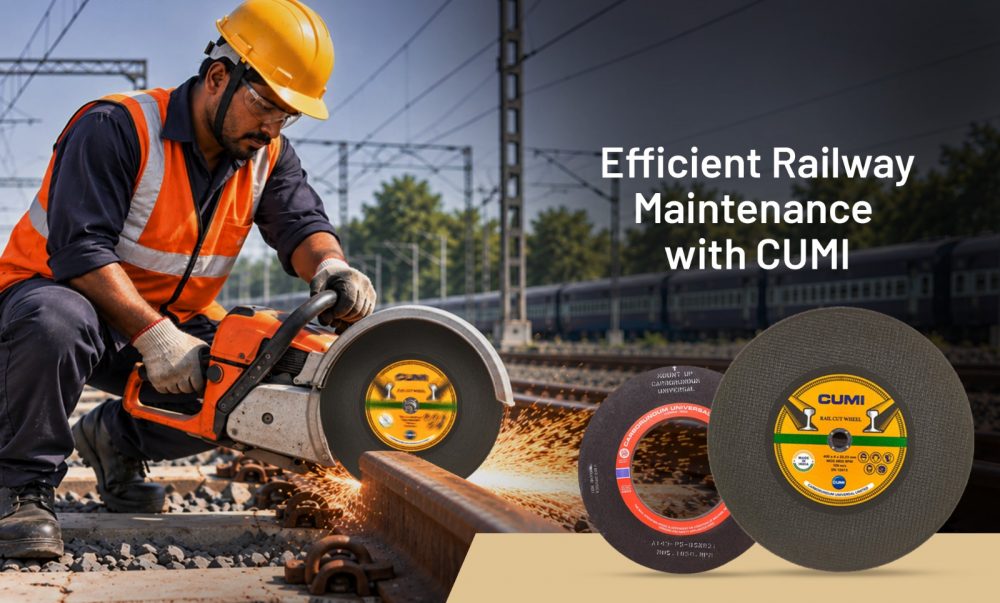
Quick Summary: Use CUMI Rail Cut (RDSO-approved, 350/400 mm, max 4,400 RPM) to section rails, and CUMI Snagging Wheels to remove excess weld and rough-grind after welding. Matching each wheel to its job, running it within its rated speed, and sourcing from an approved vendor keeps railway maintenance fast, safe and compliant.
Introduction
Railway maintenance needs precision, speed, durability and reliable abrasives. CUMI Rail Cut is built for rail cutting, while CUMI Snagging Wheels are built for heavy grinding and aggressive material removal. Choosing the right wheel for each job can raise productivity, reduce wheel consumption and cut downtime.
What Are Rail Cutting Wheels Used for in Railway Maintenance?
Rail cutting wheels are used to section rails during repair, replacement and maintenance work. Typical uses include:
- Cutting damaged rail sections
- Rail replacement and repair
- Cutting rail to required lengths
- Track maintenance and heavy-duty rail cutting
CUMI Rail Cut is built with premium grains, a special bond and fibre mesh reinforcement for use on rail cutting machines in railway and steel mill applications. It is available in 350 mm and 400 mm diameters, 3 mm and 4 mm thickness, and 22.23 mm and 25.4 mm bore sizes, as a Type 41 wheel with a maximum operating speed of 4,400 RPM. CUMI Rail Cut is an RDSO-approved product, and CUMI is listed in the RDSO-approved vendor category list.
What Are Snagging Wheels Used for in Railway Maintenance?
Snagging wheels are heavy-duty grinding wheels designed for high material removal rates. In railway maintenance they are used for:
- Weld material removal and weld dressing
- Heavy stock removal and burr removal
- Surface preparation and rough grinding
CUMI snagging wheels use specially formulated resins, toughened abrasive grains and reinforced bores for demanding high-speed grinding. See the CUMI Snagging Wheel for Pedestal and Swing Frame Grinding.
How Can CUMI Rail Cutting and Snagging Wheels Improve Efficiency?
1. Faster Rail Cutting
CUMI Rail Cut can make a cut in approximately four minutes and deliver up to six cuts on 90 UTS, 60 kg rail under specified conditions. See the full specifications table above for sizes and operating speed.
2. Efficient Material Removal
Snagging wheels are suited to rough grinding, such as removing excess weld material before finishing or inspection.
3. Reduced Interruptions
Using application-specific wheels reduces unnecessary wheel changes. The goal is to balance cutting performance, wheel life, material removal and productivity rather than choose the cheapest wheel.
4. Consistent Cutting and Grinding
CUMI Rail Cut uses premium grains, a special bond and fibre mesh reinforcement, while CUMI snagging products use toughened grains and resin systems for consistent results.
Safety and Compliance: Standards for Railway Abrasive Wheels
Railway maintenance is safety-critical work. For railway contractors and PSU procurement teams, abrasive wheel compliance is a requirement for shortlisting a supplier, not a preference. Here is what to check.
| Requirement | Why It Matters | CUMI Status |
| RDSO approval | RDSO (Research Designs and Standards Organisation) approval is typically required for products used on Indian Railways works | CUMI Rail Cut is RDSO-approved, and CUMI is listed in the RDSO-approved vendor category list |
| Bonded abrasive safety standard (EN 12413) | Sets safety requirements for bonded abrasive wheels such as cut-off and snagging wheels | Confirm with CUMI for current certification |
| Marked maximum operating speed | Running a wheel above its rated speed can cause wheel breakage | Rail Cut: 4,400 RPM. Snagging wheels: 50 m/s or 63 m/s by grade |
| Reinforcement | Reinforcement helps the wheel resist breakage under load | Rail Cut: fibre mesh. Snagging wheels: reinforced bores, safe-edge profile |
| Shelf life and expiry | Resin-bonded wheels lose strength with age and should not be used past expiry | Rail Cut: 3 years from date of manufacture |
Safe use checklist for track maintenance teams:
- Check that the machine’s spindle speed does not exceed the wheel’s marked maximum speed.
- Inspect every wheel for cracks, chips or damage before mounting.
- Check the manufacturing date and do not use expired wheels.
- Keep the wheel guard in place and use correct flanges for the bore size.
- Do not side-grind with a Type 41 cutting wheel such as Rail Cut.
- Never use a snagging wheel to cut rail. Use each wheel only for its specified application.
- Wear eye protection, face shield, hearing protection and gloves.
- Store wheels flat in a dry place, away from moisture and extreme heat.
How Are Rail Cutting and Snagging Wheels Used Together?
A typical railway maintenance workflow:
Inspection → Rail Cutting → Rail Repair/Replacement → Welding → Weld Material Removal → Surface Preparation → Inspection
Stage 1: Inspection
Decide whether the rail needs repair, replacement or sectioning.
Stage 2: Rail Cutting
Section the rail using CUMI Rail Cut. Check that the machine speed is within the wheel’s 4,400 RPM limit before starting.
Stage 3: Rail Repair or Replacement
Repair or replace the rail section according to the maintenance procedure.
Stage 4: Welding
Join the rail sections using the required welding process.
Stage 5: Weld Material Removal
Use a CUMI Snagging Wheel for aggressive grinding of excess weld material, where the equipment and application suit it.
Stage 6: Surface Preparation
Carry out the required surface preparation and finishing.
Stage 7: Final Inspection
Inspect the completed section before the track is returned to service.
Rail cutting wheels and snagging wheels are complementary, not interchangeable.
Why Choose CUMI for Railway Applications?
Choosing a supplier depends on technical support, application knowledge, product consistency and the ability to match wheels to specific operations. CUMI combines abrasive manufacturing experience with application-focused product development, and provides product specifications, application information, catalogues and selection guidance. CUMI offers a dedicated rail cutting product along with a snagging range for demanding material removal.
As part of the Murugappa Group, CUMI has manufactured abrasives in India since 1954, and is an RDSO-listed vendor for rail cutting wheels.
Sourcing Rail Cutting and Snagging Wheels for Your Railway Project?
Whether you are a railway maintenance contractor, a PSU procurement team or a dealer supplying track maintenance crews, CUMI can help you choose the right wheel and plan supply for your project.
- Request a quote or bulk supply: Share your machine model, wheel size and monthly consumption.
- Request a product trial: Test CUMI Rail Cut on your own rail cutting machine and rail grade.
- Get specifications and approval documents: Ask for technical data and RDSO approval details for your tender or vendor registration.
- Download the catalogue: See the full CUMI range on the CUMI catalogue page.
Call 1800 3000 1131 (toll-free) or send an enquiry to CUMI’s railway application team.
Frequently Asked Questions
What is a rail cutting wheel?
An abrasive wheel used to section rails and heavy metal sections.
What is CUMI Rail Cut used for?
Cutting rails and heavy steel sections on rail cutting machines, mainly in railway and steel mill applications.
Is CUMI Rail Cut approved for railway use?
Yes. CUMI Rail Cut is an RDSO-approved product.
What is a snagging wheel?
A heavy-duty grinding wheel used for aggressive material removal.
What are CUMI snagging wheels used for?
Rough grinding and heavy material removal, such as welded joints and casting cleanup.
What is the difference between rail cutting wheels and snagging wheels?
Rail cutting wheels separate rail material. Snagging wheels remove unwanted material by grinding.
Can a snagging wheel be used to cut rail?
No. Each wheel is designed for a different operation. Use wheels only as the manufacturer specifies for the application, machine and operating conditions.
How do you select a rail cutting wheel?
Consider rail material and dimensions, machine type, wheel diameter, thickness, bore, operating speed and required cutting performance.
How do you select a snagging wheel?
Consider the material, machine type, removal rate, abrasive type, grit, hardness, dimensions, speed and desired wheel life.
How do CUMI wheels improve railway maintenance efficiency?
CUMI Rail Cut supports fast, smooth cutting, and CUMI Snagging Wheels support aggressive material removal. Matching each wheel to the right operation improves productivity.
What sizes does CUMI Rail Cut come in?
350 mm and 400 mm diameter, 3 mm and 4 mm thickness, with 22.23 mm or 25.4 mm bore.
What is the maximum speed of CUMI Rail Cut?
4,400 RPM. Never run it on a machine faster than this.
What is the shelf life of CUMI Rail Cut?
3 years from the date of manufacture. Check the date before use.
How can railway contractors buy CUMI Rail Cut in bulk?
Call CUMI on 1800 3000 1131 or send an enquiry through the CUMI contact page for quotes, trials and RDSO approval documents.