
Introduction
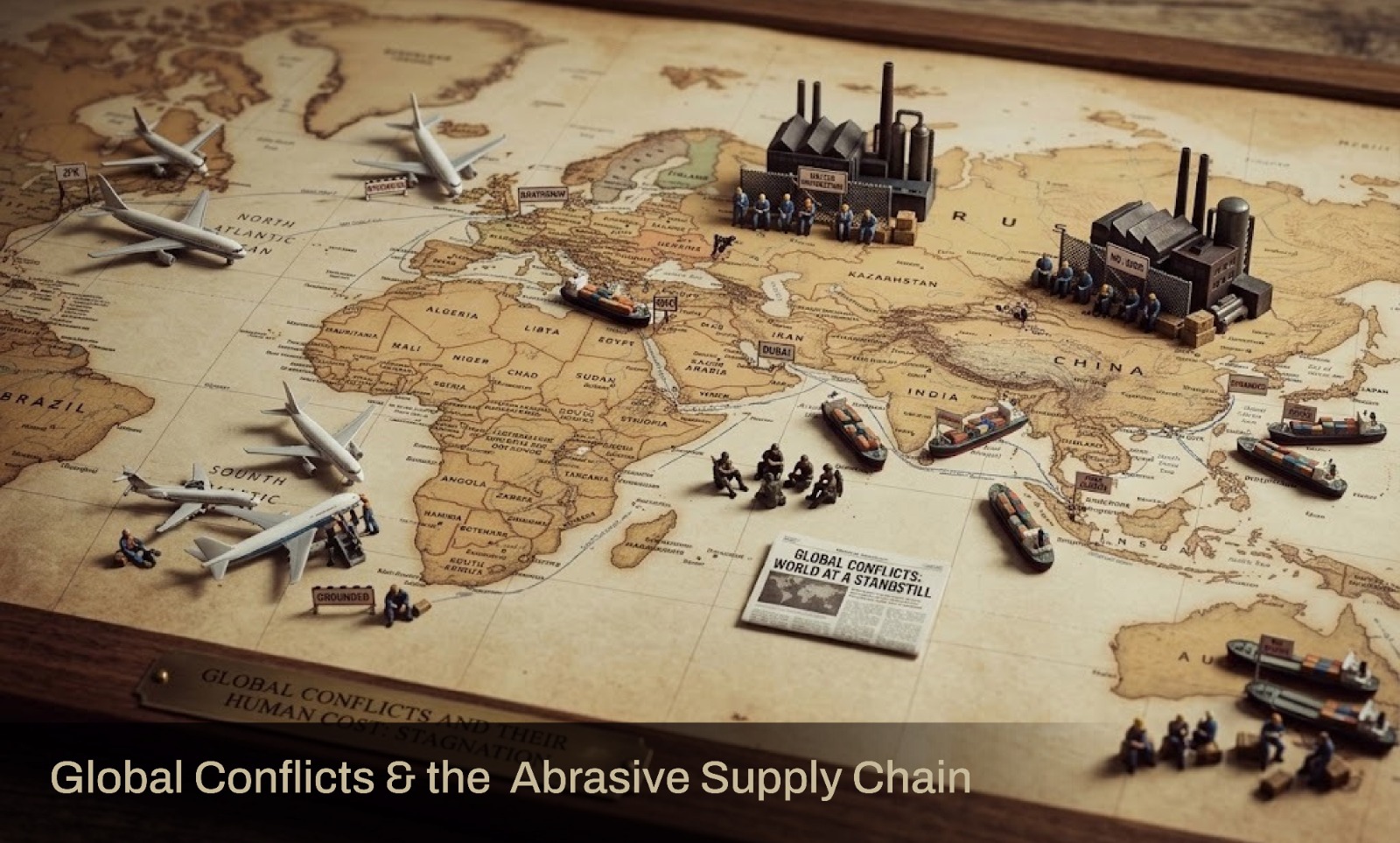
Global conflicts rarely remain confined to the countries directly involved. Their effects can spread across international trade, shipping routes, energy markets, raw-material sourcing and manufacturing operations.
For the abrasive industry, these disruptions can have a wider impact because abrasive products are an important part of manufacturing processes across industries such as automotive, steel, aerospace, bearings, metal fabrication, foundry and forging.
A disruption in the supply of raw materials or transportation can therefore create a chain reaction:
Global conflict → trade disruption → raw-material/logistics pressure → abrasive supply-chain disruption → manufacturing impact
Understanding these connections is becoming increasingly important for abrasive manufacturers as well as industrial buyers.
How Global Conflicts Disrupt Industrial Supply Chains
Modern manufacturing depends on interconnected international supply chains. A company may source raw materials from one region, manufacture products in another and distribute them to customers across several countries.
Global conflicts can disrupt this model in several ways.
1. Raw Material Supply Disruptions
Abrasive manufacturing depends on key inputs such as abrasive grains, bonds, resin and mesh. CUMI’s bonded abrasive value chain, for example, identifies these as key inputs for its manufacturing operations.
When conflicts affect mining, processing, exports or international trade, the availability and cost of these inputs can change.
This can result in:
- Longer procurement cycles
- Increased raw-material costs
- Difficulty maintaining inventory
- Greater supplier dependency
- Production-planning challenges
2. Transportation and Shipping Disruptions
Conflicts can affect shipping lanes, ports, air freight and land transportation.
Even when raw materials remain available, getting them to the manufacturing facility or delivering finished abrasive products to customers can become more complicated.
This can lead to:
Longer routes → higher freight costs → longer delivery times → increased inventory requirements
3. Energy Price Volatility
Energy is an important factor in industrial manufacturing. Geopolitical instability can affect fuel and electricity markets, increasing operating costs for manufacturers.
For abrasive manufacturers, this can influence the cost of production, transportation and distribution.
4. Trade Restrictions and Regulatory Changes
Conflicts can also result in sanctions, export restrictions, import controls and changes in trade policies.
These measures can make certain markets more difficult to serve and may force manufacturers to reconsider sourcing and distribution strategies.
What Does This Mean for the Abrasive Industry?
The abrasive industry is closely connected to the wider manufacturing ecosystem.
Grinding wheels, cutting wheels and other abrasive products are used in processes where manufacturers need to cut, grind, finish, sharpen or prepare materials.
CUMI serves a wide range of industries, including automotive, aerospace, bearing, steel, foundry & forging, transmission, renewable energy and metalworking.
Therefore, supply-chain disruptions can affect the abrasive industry in two directions:
Upstream: Difficulty sourcing materials and manufacturing inputs.
Downstream: Changes in demand from industries that use abrasive products.
How Global Conflicts Affect Grinding Wheel Manufacturing
Grinding wheels are not simply generic consumable products. Different applications require specific combinations of abrasive grain, grit, hardness, bond and wheel specifications.
CUMI’s industrial range includes grinding wheels designed for different materials and operations, including cylindrical and centreless grinding applications.
When supply-chain conditions become uncertain, manufacturers may face challenges in:
- Sourcing abrasive grains and other inputs
- Maintaining consistent production
- Managing product inventory
- Meeting customer-specific requirements
- Maintaining delivery schedules
- Controlling manufacturing costs
For industrial customers, this can become particularly important when abrasive products are part of a continuous production process.
How Supply Chain Disruptions Affect Industries That Depend on Abrasives
The impact does not stop with abrasive manufacturers.
Automotive Manufacturing
Automotive and auto-component manufacturers use grinding and finishing processes for various precision components.
If automotive production is affected by shortages, transportation problems or changing demand, abrasive requirements can also change.
Bearing Manufacturing
Precision grinding is an essential part of bearing manufacturing.
A disruption in abrasive availability can potentially affect production schedules where grinding operations are critical to component quality and dimensional accuracy.
Steel and Metal Fabrication
Steel and fabrication operations rely heavily on cutting and grinding products for material preparation, weld preparation, surface finishing and other applications.
CUMI provides abrasive solutions for metalworking and steel-related applications.
Aerospace Manufacturing
Aerospace manufacturing requires high levels of precision and process consistency. Abrasive products used in these applications therefore need to be available with appropriate specifications and performance characteristics.
Foundry and Forging
Foundries and forging operations use abrasives for material removal, fettling, finishing and other processes.
CUMI specifically identifies foundry and forging among the industries it serves.
How Abrasive Manufacturers Can Support Customers During Disruptions
Abrasive manufacturers can play a larger role than simply supplying products.
Technical teams can help customers:
- Select suitable abrasive specifications
- Identify alternative products
- Optimize grinding parameters
- Improve wheel life
- Reduce dressing frequency
- Improve productivity
- Reduce unnecessary abrasive consumption
This becomes particularly valuable when customers need to maintain production despite changing supply conditions.
CUMI highlights application-specific engineering and technical support as part of its abrasive offering, alongside products designed for different industrial requirements.
Conclusion
Global conflicts can affect the abrasive industry indirectly through raw-material availability, transportation, energy costs, trade restrictions and changes in industrial demand.
Because abrasives are used across critical manufacturing sectors, disruptions in abrasive supply can have implications beyond the abrasive industry itself.
The long-term solution is not simply to hold more inventory. It is to build a more resilient industrial supply chain supported by diversified sourcing, reliable manufacturing, effective distribution and strong technical partnerships.
For abrasive manufacturers and industrial buyers alike, resilience will increasingly become an important part of maintaining productivity and business continuity in an unpredictable global environment.
CUMI’s integrated approach to abrasives, spanning materials, manufacturing, distribution and application support, provides a strong example of how an abrasive manufacturer can build capabilities across the value chain.
Frequently Asked Questions
1. How do global conflicts affect the abrasive industry?
Global conflicts can affect the abrasive industry through raw-material shortages, transportation disruptions, energy-price changes, trade restrictions and fluctuations in industrial demand.
2. Do global conflicts affect grinding wheel prices?
They can. Changes in raw-material, energy, transportation and manufacturing costs can contribute to changes in the overall cost of producing and distributing grinding wheels.
3. How do supply-chain disruptions affect industrial abrasive buyers?
Industrial buyers may experience longer lead times, product-availability challenges, higher costs and greater uncertainty when planning production and inventory.
4. Which industries are most affected by abrasive supply-chain disruptions?
Industries that rely heavily on cutting, grinding and finishing processes—including automotive, bearings, steel, aerospace, metal fabrication, foundry and forging—can be affected when abrasive supply becomes disrupted. CUMI serves these and several other industrial sectors.
5. How can manufacturers reduce abrasive supply-chain risks?
Manufacturers can reduce risk through supplier diversification, strategic inventory planning, alternative sourcing, demand forecasting, regional supply capabilities and strong technical partnerships.
6. Why is supplier diversification important for abrasive manufacturers?
Supplier diversification reduces dependence on a single source of raw materials, manufacturing location or transportation route, giving companies greater flexibility during disruptions.
7. Can abrasive product performance help reduce supply-chain risks?
Yes. Abrasives that deliver longer life, consistent performance and fewer dressing requirements can help manufacturers improve productivity and reduce the frequency of abrasive replacement.
8. Why should industrial buyers consider technical support when selecting an abrasive supplier?
Technical support can help manufacturers select the appropriate abrasive specification, optimize grinding processes and identify suitable alternatives when production requirements or supply conditions change.
9. How important is supply-chain resilience for the future of the abrasive industry?
It is increasingly important because abrasive manufacturers operate within interconnected global supply chains. Building resilience can help companies maintain product availability and support customers during periods of market or geopolitical uncertainty.
10. How does CUMI support industrial customers?
CUMI provides abrasive products and application-focused support across multiple industrial sectors. Its portfolio includes bonded and coated abrasives, cutting and grinding products, and solutions for industries such as automotive, aerospace, bearings, steel, metalworking and foundry & forging.