

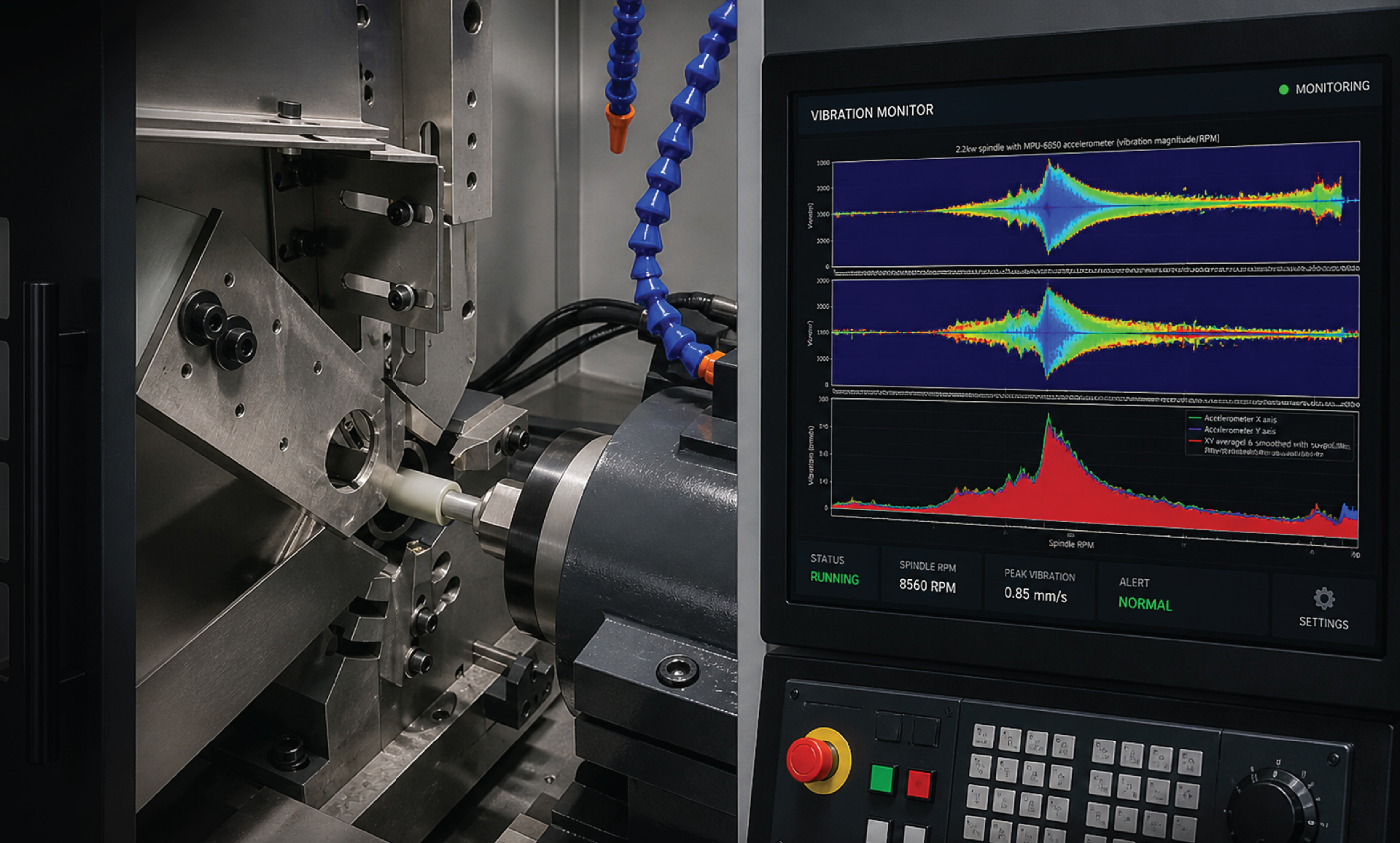
Why Vibration in Grinding Affects Surface Quality and Accuracy
Vibration in grinding processes directly impacts surface finish, dimensional accuracy, and overall process stability. Excessive vibration can lead to chatter marks, waviness, and inconsistent material removal, affecting both product quality and productivity.
Controlling vibration is essential to achieve stable grinding performance and consistent output in precision applications.
What Causes Vibration in Grinding Processes
Vibration in grinding can originate from multiple sources, and identifying the root cause is critical for effective correction.
- Mechanical causes such as imbalance in rotating components or misalignment
- Operational causes including incorrect load conditions or improper setup
- External influences such as machine resonance or environmental vibrations
Understanding the source helps determine the appropriate corrective action.
How to Identify the Nature of Grinding Vibrations
Analyzing vibration characteristics provides insight into the underlying issue.
- Frequency analysis helps determine whether vibration is linked to machine speed or resonance
- Amplitude measurement indicates the severity of vibration
- Pattern observation (continuous or intermittent) helps diagnose the type of problem
Accurate identification of vibration behavior is the first step toward effective correction
Practical Approach to Solving Grinding Vibration Issues
A structured problem-solving approach improves efficiency and reduces trial-and-error.
Step 1: Identify the Source
Determine whether the vibration is mechanical, operational, or external.
Step 2: Analyze the Behavior
Evaluate frequency, amplitude, and vibration pattern.
Step 3: Apply Corrective Action
- balance rotating components
- correct alignment
- replace worn parts
- adjust operating parameters
This systematic approach ensures targeted solutions rather than temporary fixes.
Common Vibration Problems and Their Solutions
When vibration remains constant despite speed changes
- Balance the grinding wheel to eliminate unbalance
- Adjust work speed to avoid resonance conditions
- Modify grinding parameters to reduce grinding forces
Increasing wheel speed can often stabilize the process by reducing grinding forces
When waviness appears on the workpiece
- Avoid integer ratios between spindle speed and work speed
- Balance and redress the grinding wheel
- Adjust work speed to shift away from resonance
When chatter occurs during dressing
- Replace or reposition the dressing tool
- Ensure proper dressing conditions
When spiral marks appear in cylindrical grinding
- Redress the grinding wheel properly
- Apply edge chamfer where possible
- Use angle-approach grinding to reduce marks
Key Process Factors That Influence Vibration Stability
Several parameters influence vibration behavior in grinding:
- Wheel balance and condition
- Speed ratio between wheel and workpiece
- Grinding forces and load conditions
- Machine stiffness and alignment
Proper control of these factors helps maintain stable grinding performance.
Practical Recommendations for Stable Grinding
- Conduct grinding trials to identify optimal conditions
- Select appropriate grinding wheel specifications for the application
- Maintain proper balancing and dressing practices
- Monitor machine condition and alignment regularly
Optimizing grinding conditions improves both surface finish and process stability
Expert Insight: Why Wheel Balance Plays a Critical Role
Wheel imbalance is one of the most common causes of vibration in grinding processes. Even minor imbalance can lead to amplified vibration at higher speeds, affecting both quality and tool life.
Using well-balanced grinding wheels and maintaining proper dressing practices helps reduce vibration and improve consistency.
Quick Reference: Vibration Diagnosis and Action
Issue | Likely Cause | Action |
Constant vibration | Wheel imbalance | Balance wheel |
Waviness | Speed ratio / resonance | Adjust speed |
Dressing chatter | Tool issue | Replace/adjust tool |
Spiral marks | Wheel condition | Redress wheel |
Quick Summary
Reducing vibration in grinding requires a structured approach that combines diagnosis, parameter control, and proper wheel selection.
- identify vibration source and pattern
- adjust speed and grinding parameters
- maintain proper wheel balance and dressing
- avoid resonance conditions
- optimize process through trials
Effective vibration control improves surface finish, dimensional accuracy, and overall grinding performance.
About the Author
Ashish Kumar Gupta
Global Bearing Segment Manager, CUMI

Ashish Kumar Gupta brings over 15 years of specialized expertise in bearing grinding processes to his role as CUMI’s Global Bearing Segment Manager. With qualifications in Mechanical Engineering (BE), Operations Management (MBA), and Quality Management Systems (M.Tech.), Ashish combines engineering knowledge with practical manufacturing experience.
As a former member of SKF’s grinding community and subject matter expert in grinding and honing processes, Ashish has led over 20 successful grinding optimization projects across major bearing manufacturers. His systematic approach to process improvement has delivered measurable results: 10% cycle time reduction, 20% productivity improvements, and 20% cost per component savings for clients worldwide.
Connect with Ashish: LinkedIn Profile