
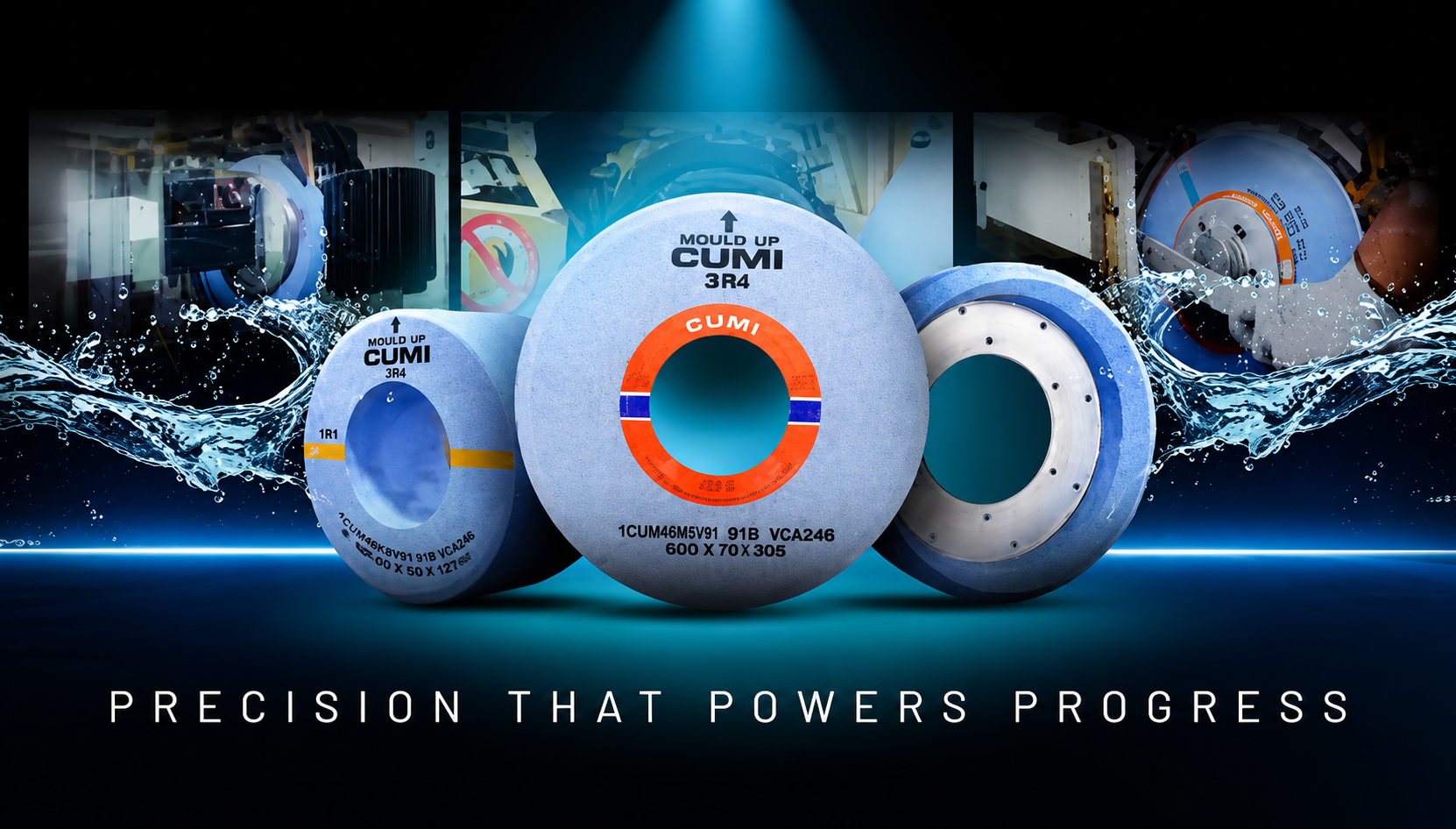
CUMI’s engineered gear grinding wheel range delivers profile accuracy, superior surface finishes, and extended wheel life across demanding industrial production environments.
 Watch the Official Video
Channel: CUMI – Carborundum Universal Limited
Video: https://youtu.be/1T7kXnoquxg?si=cNgKj_GQtMmqr2ZA
“Gears — the heartbeat of progress and innovation. Every turn reflects the pursuit of perfection where engineering, innovation and precision converge.”
Why Gear Grinding Precision Matters
In modern gear manufacturing, precision directly affects component performance, operational noise, efficiency, and service life.
Whether it is:
- Passenger vehicle transmission systems
- Aircraft turbine gear mechanisms
- Wind turbine drive systems
- Industrial gearboxes
- Railway transmission components
Every gear tooth profile must maintain:
- Dimensional accuracy
- Surface finish quality
- Profile consistency
- Thermal stability
- Long operational life
CUMI’s gear grinding wheel portfolio is engineered to address these production requirements while improving material removal efficiency and cycle times.
Types of Gear Grinding Wheels in CUMI’s Range
1. Profile Grinding Wheels
Designed for high-precision profile grinding applications.
Key Features
- High-force regime bond system
- Specific material removal rate up to 15 per flank
- Excellent profile retention
- High-speed operation capability
- Reduced dressing depth and frequency
- Improved productivity
Suitable Applications
- Wind turbine gears
- Industrial gearboxes
- Large module gears
- Precision tooth profile grinding
2. Generative Gear Grinding Wheels
Developed for continuous gear generation processes requiring productivity and thermal stability.
Key Features
- Micro-crystalline abrasive grains
- Porous structure with integrated cooling
- Reduced heat generation
- Lower thermal damage risk
- Precision vitrified bond
Longer wheel life
Benefits
- Stable cutting performance
- Better coolant penetration
- Improved profile consistency
- Reduced downtime
3. Bevel Gear Grinding Wheels
Built for complex bevel gear applications requiring smooth finishes and controlled wear.
Key Features
- Self-sharpening micro-crystalline grains
- High stock removal capability
- Cooler cutting action
- Controlled wear pattern
- Scratch-free surface quality
Typical Uses
- Differential gears
- Aerospace transmission systems
- Heavy engineering components
- Precision gearbox manufacturing
Performance Specifications and Operator Benefits
| Performance Parameter | CUMI Specification | Production Benefit |
|---|---|---|
| Material Removal | Specific removal rate of 15 per flank | Faster production cycles |
| Grain Technology | Micro-crystalline aluminium oxide | Extended sharpness retention |
| Cooling System | Porous integrated cooling | Lower thermal damage |
| Bond System | Precision vitrified bond | Consistent profile accuracy |
| Wheel Life | Reduced dressing intervals | Lower downtime |
| Surface Finish | Scratch-free precision finish | OEM quality compliance |
Featured Gear Grinding Products
Bevel Gear Grinding Wheel
Designed for precision bevel gear manufacturing using:
- Micro-crystalline abrasive technology
- Advanced bond systems
- High surface finish quality
- Controlled wear characteristics
Single Profile Rib Gear Grinding Wheel
Suitable for:
- Individual tooth flank grinding
- High-module gears
- Wind energy systems
- Industrial gearbox production
Multi-Rib Gear Grinding Wheel
Developed for advanced gear grinding environments where multiple process variables are controlled simultaneously.
Applications include:
- High-volume manufacturing
- Precision gear systems
- Complex production lines
- Industrial transmission components
Bonded Abrasives Product Portfolio
CUMI’s bonded abrasives range includes the following:
- Gear grinding wheels
- Bearing grinding solutions
- Cylindrical grinding wheels
- Surface grinding wheels
- Thread grinding products
Industries Using Gear Grinding Wheels
CUMI gear grinding wheels support manufacturers across multiple industrial sectors:
Automotive
Transmission gears, driveline components, precision gear systems
Aerospace
Aircraft gearboxes, turbine assemblies, flight transmission components
Wind Energy
Wind turbine gear systems and large module gears
Heavy Engineering
Industrial machinery and load-bearing transmission systems
Industrial Gearboxes
High-load gearbox manufacturing applications
Railway
Rail transmission and motion systems
Machine Tools
Precision engineering and motion control components
Application Engineering Support
Grinding wheel performance depends not only on wheel selection but also on process optimization.
CUMI application engineers assist manufacturers with:
- Wheel specification selection
- Dressing cycle optimisation
- Machine parameter matching
- Surface finish troubleshooting
- Profile correction
- Process diagnostics
This support helps manufacturers maintain the following:
- Production consistency
- Lower downtime
- Improved throughput
- Better output quality
About CUMI
CARBORUNDUM UNIVERSAL LIMITED (CUMI)
Founded in 1954 under the Murugappa Group, CUMI pioneered bonded and coated abrasives manufacturing in India.
With over 70 years of engineering expertise, CUMI supplies abrasive solutions for the following:
- Automotive industries
- Aerospace manufacturing
- Industrial engineering
- Precision machining
- Heavy equipment production
Product categories include:
- Bonded abrasives
- Coated abrasives
- Super abrasives
- Precision grinding solutions
Frequently Asked Questions
1) What is a profile gear grinding wheel?
A profile gear grinding wheel matches the geometry of the gear tooth space and grinds individual tooth flanks while maintaining profile accuracy. These wheels are commonly used for large gears and industrial gearbox applications.
2) What is the difference between profile grinding and generative grinding?
Profile grinding shapes individual gear tooth spaces directly using dressed wheel geometry.
Generative grinding creates tooth profiles through continuous meshing motion between wheel and workpiece, making it suitable for high-volume production.
3) Why are micro-crystalline aluminium oxide grains preferred?
These grains continuously expose new cutting edges through controlled fracture, providing the following:
- Self-sharpening action
- Longer wheel life
- Better surface quality
- Reduced dressing frequency
4) What are vitrified bonds in grinding wheels?
Vitrified bonds use glass-like bonding systems that provide:
- Structural rigidity
- Profile retention
- Better coolant flow
- Reduced heat generation
5) What does “15 per flank” material removal mean?
It represents grinding productivity measured as material removed per tooth flank. Higher values improve production speed and reduce cycle time.
6) How are scratch-free finishes achieved?
Scratch-free surfaces are obtained through the following:
- Self-sharpening grains
- Cooler cutting operation
- Controlled wheel wear
- Reduced thermal damage
This improves gear surface integrity and operational performance.