

The Role of Abrasive Coating in Sandpaper Performance
The coating structure of sandpaper determines how abrasive grains are distributed across the surface, directly influencing cutting efficiency, clogging behavior, and finish quality. Open coat vs closed coat are the two primary coating types used in sandpaper, and each is designed for different sanding conditions.
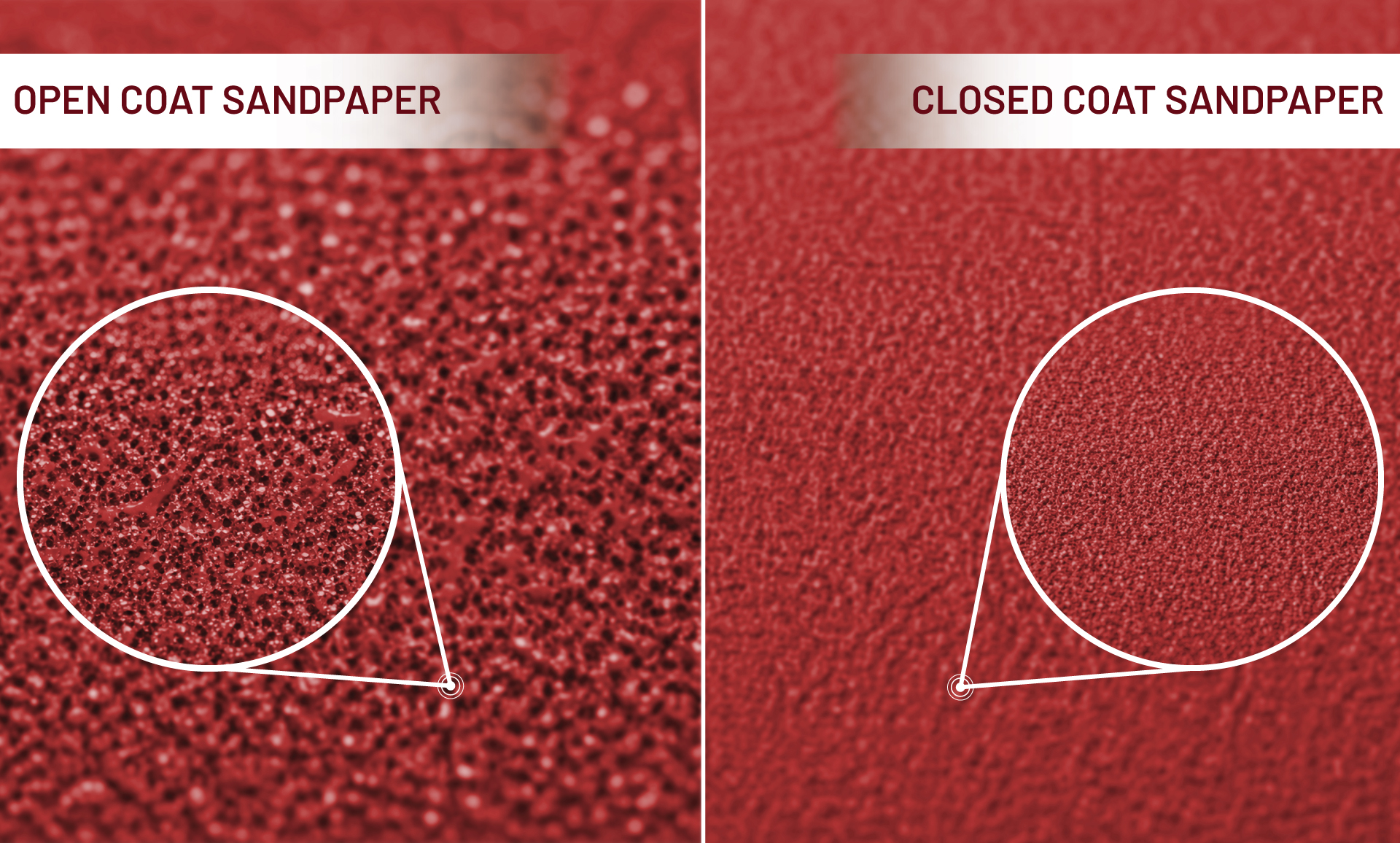
Closed coat sandpaper has a dense grain distribution, which provides faster material removal. Open coat sandpaper has spaced abrasive grains, allowing better dust clearance and reduced clogging.
Selecting the correct coating type improves sanding efficiency, extends abrasive life, and ensures consistent surface preparation.
Abrasive coating is one of several technical factors that influence sanding performance, alongside abrasive material and grit selection, which together determine cutting efficiency and surface finish quality.
Open Coat Sandpaper: Structure and Performance Characteristics
Open coat sandpaper is designed with abrasive grains spaced apart. This spacing creates gaps that allow sanding debris to escape during operation.
Because of this structure, open-coat sandpaper reduces clogging when sanding soft or thick materials. It is particularly useful when working with materials that generate fine dust or sticky residues.
Typical performance characteristics include the following:
- reduced clogging during sanding
- cooler cutting due to better airflow
- longer usability in dusty applications
- slightly lower cutting speed compared to closed coat
In woodworking and furniture preparation processes, open coat sandpaper is commonly used because it helps maintain consistent sanding performance while reducing surface loading during extended sanding
Closed Coat Sandpaper: Structure and Cutting Behavior
Closed-coat sandpaper has a high density of abrasive grains. This dense grain arrangement allows more cutting points per unit area.
As a result, closed-coat sandpaper delivers faster and more aggressive material removal compared to open-coat abrasives.
Typical performance characteristics include the following:
- higher cutting efficiency
- uniform scratch pattern
- faster stock removal
- higher risk of clogging in soft materials
Closed coat sandpaper is often used in applications where speed and surface uniformity are priorities.
In applications where faster material removal is required, selecting the right abrasive type along with coating structure plays a key role in achieving consistent surface preparation results.
Applications Where Open Coat Sandpaper Performs Best
Open-coat sandpaper is preferred in applications where dust generation and clogging are major concerns. Its spaced grain structure allows debris to clear efficiently, maintaining consistent sanding performance.
Typical applications include the following:
- sanding softwood surfaces
- woodworking and furniture preparation
- sanding painted or coated wood
- working with resinous materials
For woodworking applications, open coat sandpaper is often used to maintain surface consistency while reducing abrasive loading.
Applications Where Closed Coat Sandpaper Is Preferred
Closed coat sandpaper is suitable for applications requiring faster material removal and a uniform scratch pattern. Its dense grain structure allows efficient cutting, especially on harder materials.
Typical applications include the following:
- sanding hardwood surfaces
- metal surface preparation
- removing coatings quickly
- industrial surface preparation
Closed coat abrasives are commonly used in applications where productivity and cutting speed are critical.
Selecting the Right Coating Based on Application
Choosing between open coat and closed coat sandpaper depends on the material being sanded and the sanding objective.
Open-coat sandpaper is generally suitable for soft materials and dust-heavy applications because it reduces clogging and maintains cutting efficiency.
Closed coat sandpaper is more effective for harder materials or when faster material removal is required. Sanding efficiency also depends on selecting the correct grit sequence, as improper grit progression can lead to uneven surfaces and visible scratch patterns after finishing.
Selecting the appropriate coating improves sanding efficiency, reduces downtime caused by clogging, and enhances overall surface finish quality.
Practical Sanding Workflow Using Open and Closed Coat Abrasives
Many sanding processes use both coating types at different stages to balance efficiency and surface quality.
A typical workflow includes:
- initial sanding with closed coat sandpaper for faster material removal
- intermediate sanding using appropriate grit progression
- finishing with open-coat sandpaper to reduce clogging and refine the surface
This approach helps maintain productivity while improving finishing consistency.
Incorrect sanding practices or skipping sanding stages can result in surface defects, reduced coating adhesion, and inconsistent finishing outcomes.
Expert Insight: Why coating structure impacts abrasive life
Abrasive coating density directly influences how sandpaper performs under different sanding conditions. Closed coat abrasives provide more cutting points, increasing cutting speed but also generating more heat and debris accumulation.
Open-coat abrasives, with their spaced-grain structure, allow better airflow and debris clearance. This reduces clogging and extends usable life in applications involving soft or resinous materials.
In industrial and woodworking environments, selecting the appropriate coating type based on material characteristics is a key factor in achieving consistent sanding performance.
Quick Summary
Open-coat and closed-coat sandpapers are designed for different sanding conditions.
- Open-coat sandpaper reduces clogging and is suitable for wood and dust-heavy applications.
- Closed-coat sandpaper provides a smooth finish and is suitable for harder materials and high stock removal.
- Many sanding workflows use both coating types to balance efficiency and surface quality.
Selecting the correct coating type improves sanding performance, abrasive life, and finishing consistency.
About the Author
This article was prepared by the CUMI Abrasives technical team, part of Carborundum Universal Limited, a Murugappa Group company with extensive experience in abrasive manufacturing and surface preparation technologies.
The insights presented are based on practical applications of abrasive materials used in woodworking, metalworking, and industrial finishing processes.