

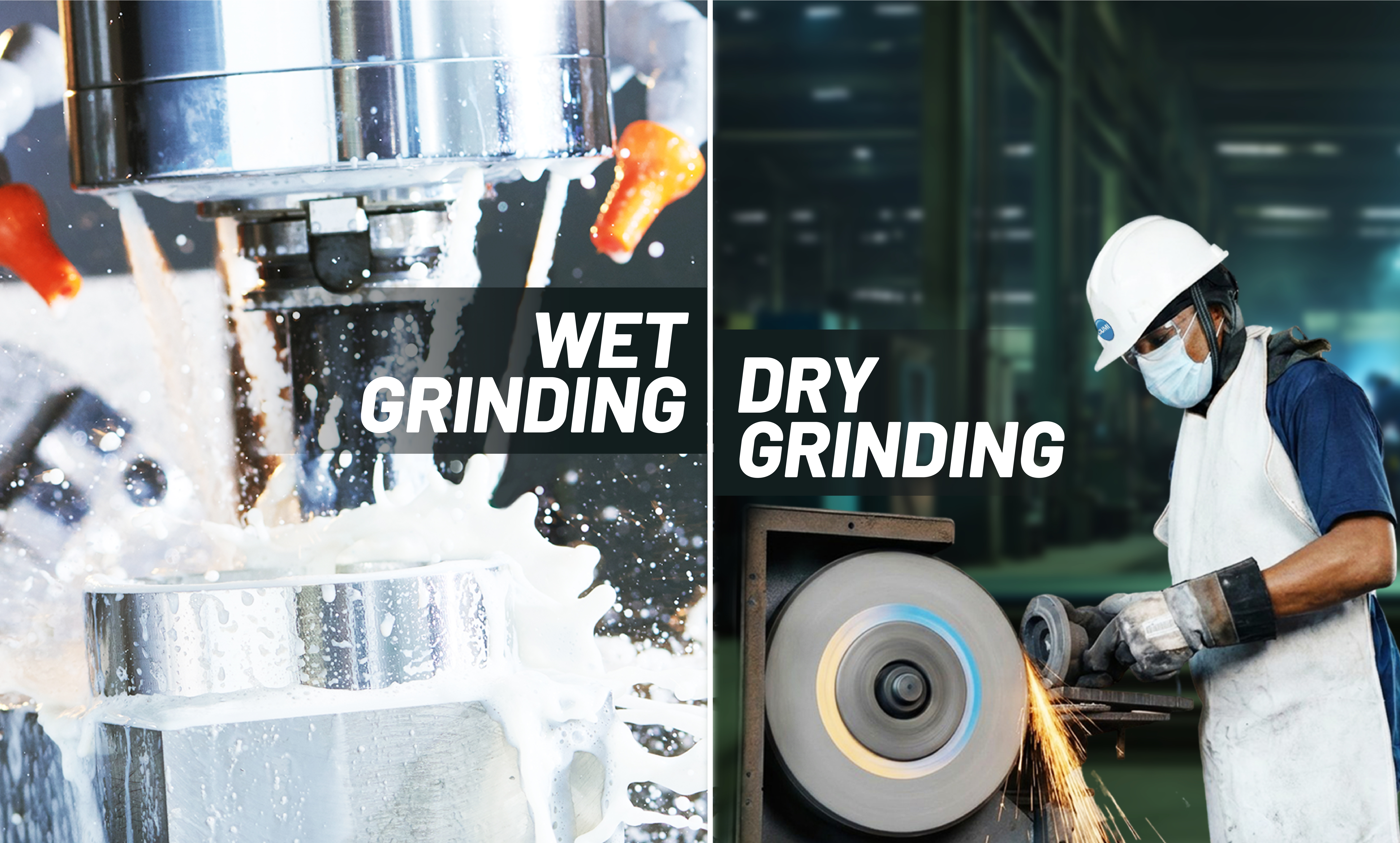
In industrial grinding, choosing between wet grinding and dry grinding directly affects cycle time, surface quality, tool life, safety, and operating cost. There is no universally “better” method—the right choice depends on material, heat sensitivity, finish requirement, and production volume.
This guide explains when to use wet grinding, when dry grinding is more effective, and how industrial users make the right decision.
The Core Difference Between Wet and Dry Grinding
Wet grinding uses a coolant or liquid to control heat, flush debris, and improve surface quality.
Dry grinding relies on airflow and abrasive design to remove material without liquid cooling.
Both methods are widely used—but for very different reasons.
When Wet Grinding Is the Right Choice
Wet grinding is preferred when heat control and surface integrity are critical.
Typical Applications
- Precision components
- Hardened steels
- Bearings and aerospace parts
- Surface and cylindrical grinding
- Tight dimensional tolerance jobs
Key Advantages of Wet Grinding
- Superior heat dissipation
- Reduced grinding burns and micro-cracks
- Improved surface finish
- Longer abrasive and wheel life
- Better dimensional stability
Trade-Offs to Consider
- Coolant system cost and maintenance
- Disposal and environmental handling
- Higher setup complexity
Best suited for:
High-precision, high-value components where quality outweighs speed.
When Dry Grinding Is the Right Choice
Dry grinding is chosen for speed, simplicity, and lower operational complexity.
Typical Applications
- Rough grinding and stock removal
- Fabrication and weld grinding
- Construction and maintenance jobs
- Portable and on-site grinding
Key Advantages of Dry Grinding
- Faster setup and changeover
- No coolant management required
- Lower operating and maintenance costs
- Suitable for mobile and outdoor work
Trade-Offs to Consider
- Higher heat generation
- Greater dust control requirements
- Increased risk of surface damage if poorly controlled
Best suited for:
High-throughput or on-site operations where speed and flexibility matter most.
Heat Control: The Deciding Factor in Most Applications
Heat is the primary differentiator between wet and dry grinding.
Why Heat Matters
Excessive heat can cause:
- Grinding burns
- Surface cracks
- Metallurgical changes
- Component rejection or rework
How Each Method Handles Heat
- Wet grinding: Coolant absorbs and removes heat immediately.
- Dry grinding: Relies on abrasive sharpness, airflow, and operator control
If heat-related defects are frequent, wet grinding is usually the correct choice.
Impact on Cycle Time and Productivity
Wet Grinding
- Slower material removal in some cases
- Fewer regrinds and rejections
- More consistent output
Dry Grinding
- Faster initial material removal
- Shorter setup time
- Higher risk of rework if not controlled
Key insight:
Dry grinding may appear faster per pass, but wet grinding often wins at scale by reducing downstream corrections.
Abrasive Life and Cost Implications
Abrasive Performance in Wet Grinding
- Slower wear rate
- Less glazing and loading
- Fewer dressing cycles
Abrasive Performance in Dry Grinding
- Faster wear due to heat
- Requires heat-resistant abrasive types
- More frequent replacement
Total cost impact:
Wet grinding often lowers cost per component, while dry grinding lowers cost per setup.
Environmental and Safety Considerations
Wet Grinding
- Requires coolant handling and disposal
- Cleaner air environment
- Reduced airborne dust
Dry Grinding
- Generates dust and sparks
- Requires effective extraction systems
- Higher PPE dependence
Safety-critical environments often favour wet grinding, while field jobs favour dry grinding.
How Industrial Manufacturers Choose Between Wet and Dry Grinding
Leading plants evaluate:
- Material hardness and heat sensitivity
- Required surface finish
- Volume and repeatability
- Infrastructure availability
- Environmental compliance
Many facilities use both methods, optimized by application rather than standardized across the plant.
Common Mistakes When Choosing Grinding Methods
- Using dry grinding for heat-sensitive materials
- Assuming wet grinding is always slower
- Ignoring dust and safety implications
- Selecting grinding method before abrasive optimisation
Correct method selection should follow process evaluation, not habit.
Final Thoughts
Choosing between wet and dry grinding is not a binary decision—it is a process optimization choice.
The right method improves productivity, quality, safety, and total cost efficiency.
By matching grinding methods to application requirements, industrial users can achieve consistent results and sustainable performance improvements.
Frequently Asked Questions
1. What is the difference between wet grinding and dry grinding?
Wet grinding uses coolant or liquid to control heat, flush debris, and protect the workpiece surface during grinding. Dry grinding operates without coolant, relying on abrasive design and airflow for material removal. The right choice depends on material heat sensitivity, required surface finish, production volume, and whether coolant infrastructure is available on-site.
2. What are the benefits of wet grinding over dry grinding?
Wet grinding provides better heat dissipation, improved surface finish, reduced grinding burns, longer abrasive life, lower risk of micro-cracks, and improved dimensional accuracy. It is commonly used for precision components and tight-tolerance applications. While wet grinding has higher setup costs, it often lowers total cost per component by reducing rework and rejection rates.
3. What is wet grinding in industrial applications?
Wet grinding is a material removal process where coolant is supplied during grinding operations to reduce heat, remove chips, and protect the workpiece surface. It is widely used in aerospace, bearing manufacturing, hardened steels, and precision machining.
4. What is dry grinding, and where is it used?
Dry grinding means performing material removal without any coolant or liquid. It is commonly used for rough grinding, stock removal, fabrication work, weld finishing, maintenance jobs, and portable on-site grinding applications where faster setup and lower complexity are required over precision finish.
5. Is wet grinding better than dry grinding for surface finish?
Yes. Wet grinding generally produces a better surface finish because coolant reduces friction and heat generation. This helps prevent grinding burns, thermal damage, and visible surface defects.
6. What does wet grinding mean?
Wet grinding means performing a grinding operation while continuously applying coolant—usually a water-based fluid—to the cutting zone. The coolant controls heat, removes debris, and preserves surface quality. It is the standard method in precision industrial grinding where surface integrity cannot be compromised.
7. What does dry grinding mean?
Dry grinding means grinding a material without the use of any coolant or liquid. The abrasive wheel cuts using only mechanical action and airflow for cooling. It is widely used in fabrication, construction, and maintenance grinding where portability and speed matter more than surface precision.
8. What is the difference between a wet grinder and a dry grinder?
A wet grinder uses coolant during the grinding process to control heat and improve surface finish, making it suitable for precision and high-value components. A dry grinder operates without coolant, offering faster setup and simpler operation for rough grinding, fabrication, and on-site work. The choice between the two depends on the material, required finish, and production environment.
9. What is the wet grinding process in industrial manufacturing?
The wet grinding process involves feeding coolant continuously into the contact zone between the abrasive wheel and the workpiece during grinding. This controls temperature, flushes away chips and swarf, reduces wheel loading, and maintains consistent surface quality. It is the standard process for bearing rings, aerospace components, hardened steels, and any precision grinding operation.
10. What equipment is recommended for dry grinding in industrial applications?
Dry grinding in industrial settings uses angle grinders, bench grinders, surface grinders with dust extraction, or portable grinding machines fitted with heat-resistant abrasive wheels. The critical requirements are proper dust extraction systems, correct abrasive grade selection for dry use, and adequate PPE — since dry grinding generates both significant heat and airborne particulate matter.