
Quick Summary: Safe foundry grinding depends on strict adherence to international safety certifications (EN 12413 & ANSI B7.1), verified machine RPM matching, pre-use inspection (including ring tests), correct wheel-to-application selection, and following manufacturer mounting and operating instructions.
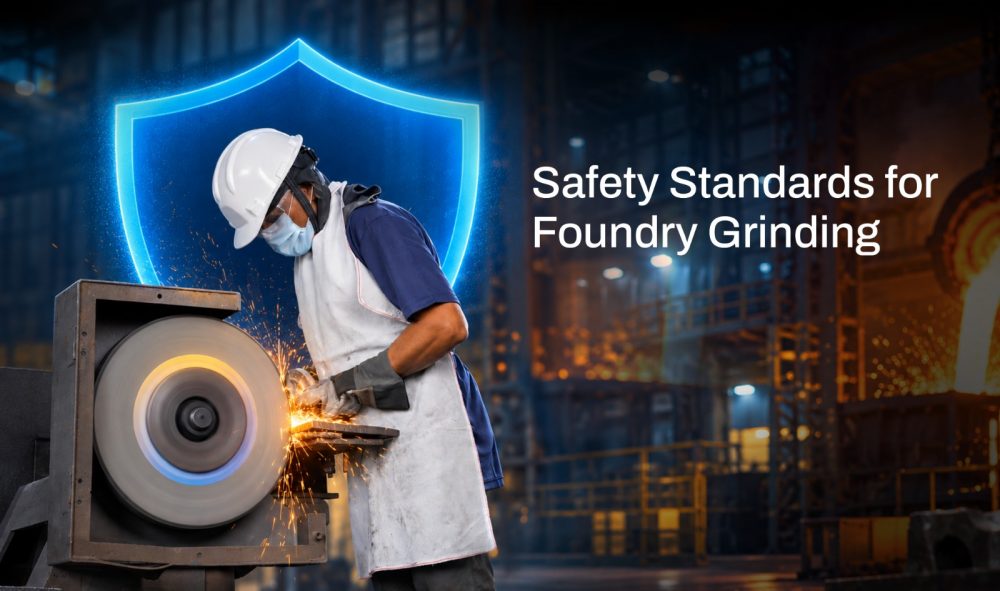
Foundry grinding is one of the most demanding abrasive applications in metal manufacturing. Castings and forged components often require heavy material removal, surface preparation, fettling, and dimensional correction before they move to machining or finishing. Because these operations involve high grinding loads and high-speed abrasive wheels, grinding wheel safety standards are just as important as grinding performance.
So, what safety standards should foundry grinding wheels meet?
For bonded abrasive grinding and cutting products, EN 12413 is a key European safety standard, while ANSI B7.1 provides widely recognised safety requirements for the use, care, and protection of abrasive wheels. CUMI states that its cutting and grinding wheels are manufactured with stringent process controls and final quality checks to maintain product safety in accordance with both standards.
However, choosing a safety-rated grinding wheel is only the starting point. Foundries must also select the right wheel for the application, verify the rated operating speed, inspect the wheel before use, mount it correctly, and follow the manufacturer’s operating instructions.
Why Is Grinding Wheel Safety Important in Foundries?
Foundry grinding is different from light-duty metal finishing. Castings can contain excess material, gates, risers, flash, and uneven surfaces that require aggressive stock removal.
CUMI describes foundry grinding as rapid material removal from cast or forged components to meet dimensional and surface specifications — shaping large parts and removing excess bulk. CUMI’s Foundry & Forging page identifies Resinoid Snagging Wheels as the product option for this operation.
During this type of work, grinding wheels experience significant mechanical and thermal loads. Incorrect RPM, improper mounting, misalignment, excessive side pressure, and thermal stress are the leading causes of grinding wheel failure in foundry operations.
Core Safety Standards: EN 12413 vs. ANSI B7.1
Foundry grinding subjects wheels to extreme mechanical and thermal stresses. To ensure operator safety, two primary standards govern CUMI’s foundry abrasive line:
| Standard | Region | What It Governs |
|---|---|---|
| EN 12413 | European | Design, structural strength, manufacturing process controls, and quality checks of bonded abrasive products |
| ANSI B7.1 | American (National) | User-side safety — proper handling, storage, mounting, wheel guards, machine speed limits, and operating procedures |
EN 12413 matters most when selecting wheels for demanding applications such as heavy stock removal, foundry fettling, casting surface preparation, riser and runner removal, and grinding of cast or forged components.
ANSI B7.1 matters because a grinding wheel should never be selected on material removal rate alone — its specifications must be compatible with the grinding machine and the intended application. This is especially important when using portable grinders, angle grinders, or swing-frame grinding equipment.
4 Pre-Operation Checks Before Using a Foundry Wheel
1. Verify Maximum Operating Speed (RPM)
The operating speed of the grinding machine must never exceed the wheel’s specified maximum rated speed. Centrifugal forces at high RPMs can cause wheel failure if mismatched. Before mounting, verify: wheel diameter, maximum RPM, machine RPM, wheel specification, and machine compatibility. Never assume a wheel built for one machine can automatically be used on another.
2. Inspect the Wheel Before Mounting
Inspect all wheels for visible damage or cracks. Perform a ring test where applicable — tap the wheel lightly with a non-metallic implement; a clear metallic ring indicates integrity, while a dull thud signals internal cracks. Do not use a wheel that appears damaged or otherwise unsuitable.
3. Check the Expiry Date
Resinoid bonds degrade over time due to environmental conditions like humidity. Always check the expiration date and identification information stamped on the wheel hub before installation.
4. Select the Correct Wheel & Ensure Machine/Flange Compatibility
Verify wheel diameter, bore size, and machine guard setup. Never force a wheel onto an oversized spindle or alter mounting flanges. The abrasive should be selected according to the material being ground, stock to be removed, casting/forging type, grinding machine, required removal rate, surface condition, and grinding operation.
Safety Warning: Incorrect RPM, improper mounting, misalignment, excessive side pressure, and thermal stress are leading causes of grinding wheel failure in foundry operations.
CUMI Foundry & Forging Wheel Selector
| CUMI Product | Primary Application | Target Material | Equipment / Machine |
|---|---|---|---|
| HI-CARB DC Foundry Wheel | Heavy-duty stock removal, cast iron grinding | Ductile Iron & Cast Iron | Angle Grinders |
| PRO Max 16 Hot Press Wheel | Casting fettling, heavy riser/runner removal | Stainless, High-Alloy & Carbon Steel | Swing-Frame Grinders |
| HI-CUT DC Wheel | Weld blending, edge grinding, deburring | Cast Iron, Carbon & Stainless Steel | Portable Angle Grinders |
| AGNI-S DC Wheel | Heavy stock removal, high-pressure grinding | Heavy Forgings & Structural Steel | Heavy-Duty Angle Grinders |
| Samurai DC Grinding Wheel | Routine maintenance & light metal removal | Mild Steel & General Metals | Standard Angle Grinders |
| Portable Snagging Wheel | Aggressive bulk stock removal | Steel Fabrication & Castings | Portable Snagging Grinders |
Product Notes
HI-CARB DC Foundry Wheel — Engineered for demanding foundry and forging applications on ductile iron and cast iron. A heavy-duty depressed-centre wheel built for aggressive stock removal, available in 180 mm and 230 mm diameters with multiple thickness and bore options. Known for robust construction and extended service life — a strong fit for foundries working primarily with cast iron and ductile iron.
CUMI PRO Max 16 Hot Press Wheel — Built for heavy-duty material removal on swing-frame grinders, using zirconia abrasive grains suited to stainless steel, high-alloy steel, and carbon steel. Positioned for casting fettling, riser removal, and rough grinding of forged components. The hot-press manufacturing process delivers uniform bond strength for stability at high speed.
HI-CUT DC Wheel — A Type 27 depressed-centre wheel for weld blending, edge grinding, surface preparation, deburring, and tool sharpening across cast iron, carbon steel, stainless steel, and structural steel. Useful where grinding needs extend beyond heavy casting removal into surface finishing.
AGNI-S DC Wheel — A heavy-duty depressed-centre wheel with strong abrasive grains and a reinforced resin bond system, built for high material removal with reduced chipping. Designed for angle grinders in foundry & forging and steel applications requiring aggressive, controlled removal.
Samurai DC Grinding Wheel — Designed for routine metal grinding and cutting across foundry, metal, and steel industries. Its self-sharpening abrasive grains and special bond system maintain cutting performance and extend wheel life, with reduced dust and fumes.
Application Matching: Foundry Grinding vs. Deburring vs. Runner/Riser Removal
Using the wrong wheel for a specific operation risks premature wear or dangerous wheel failure:
- Foundry Grinding / Snagging: Requires resinoid-bonded snagging or hot-pressed wheels designed for rapid, heavy stock removal on cast or forged components.
- Deburring: Requires depressed-centre (DC) wheels engineered to remove sharp edges and burrs with minimal chipping.
- Runner & Riser Removal: Requires high-strength resinoid wheels designed to slice through heavy feeder channels safely.
Choosing the wheel according to the specific operation — rather than treating every foundry grinding task the same — is what prevents both premature wear and unsafe failure.
Frequently Asked Questions
What safety standards apply to grinding wheels?
EN 12413 is an important standard for bonded abrasive products, while ANSI B7.1 provides safety requirements relating to the use, care, and protection of abrasive wheels. CUMI states its cutting and grinding products are manufactured with safety maintained in accordance with both.
What is a foundry grinding wheel used for?
A foundry grinding wheel is used for heavy material removal, surface preparation, and shaping of cast or forged components — rapid removal to meet dimensional and surface requirements.
Which CUMI wheel is suitable for heavy foundry grinding?
It depends on material and machine. The HI-CARB DC Foundry Wheel is designed for heavy grinding of cast iron and ductile iron, while the PRO Max 16 Hot Press Wheel is built for swing-frame grinding of stainless steel, high-alloy steel, and carbon steel.
What is a snagging grinding wheel?
A wheel designed for aggressive material removal from rough cast or forged components — commonly used in foundry fettling and heavy grinding where large amounts of excess material must be removed.
How do I check a grinding wheel before use?
Inspect for visible damage, check identification and expiry information, verify rated operating speed, and perform the appropriate inspection procedure, such as a ring test where applicable.
What causes grinding wheel breakage?
Improper RPM, incorrect mounting, misalignment, thermal stress, and sudden side pressure — correct mounting, suitable guards and flanges, proper RPM, and controlled feed reduce this risk.
Which CUMI grinding wheel is suitable for cast iron?
The HI-CARB DC Foundry Wheel — a heavy-duty wheel purpose-built for aggressive material removal on cast iron and ductile iron.
CUMI’s Approach to Safe and Efficient Foundry Grinding
Foundry grinding requires more than high stock removal. The grinding wheel must be appropriate for the material, machine, and operation, while its rated speed, condition, mounting, and operating method must be carefully controlled.
CUMI’s Foundry & Forging portfolio addresses key operations including heavy grinding, deburring, and runner/riser removal, with product options spanning resinoid snagging wheels, DC wheels, and resinoid grinding wheels. Ultimately, safe foundry grinding comes down to three fundamentals: select the right wheel, operate it within its specified limits, and follow correct inspection, mounting, and grinding practices.