
Every Micron Matters in Bearing Manufacturing
In precision bearing manufacturing, inner ring grinding is one of the most demanding finishing operations. Consistent dimensional accuracy, surface finish and process stability are essential for product reliability. Grinding wheel performance directly influences wheel life, dressing frequency, machine availability and productivity. Modern manufacturers therefore monitor KPIs such as Overall Equipment Effectiveness (OEE), wheel life and Cost Per Component to drive continuous improvement.
The Manufacturing Challenge
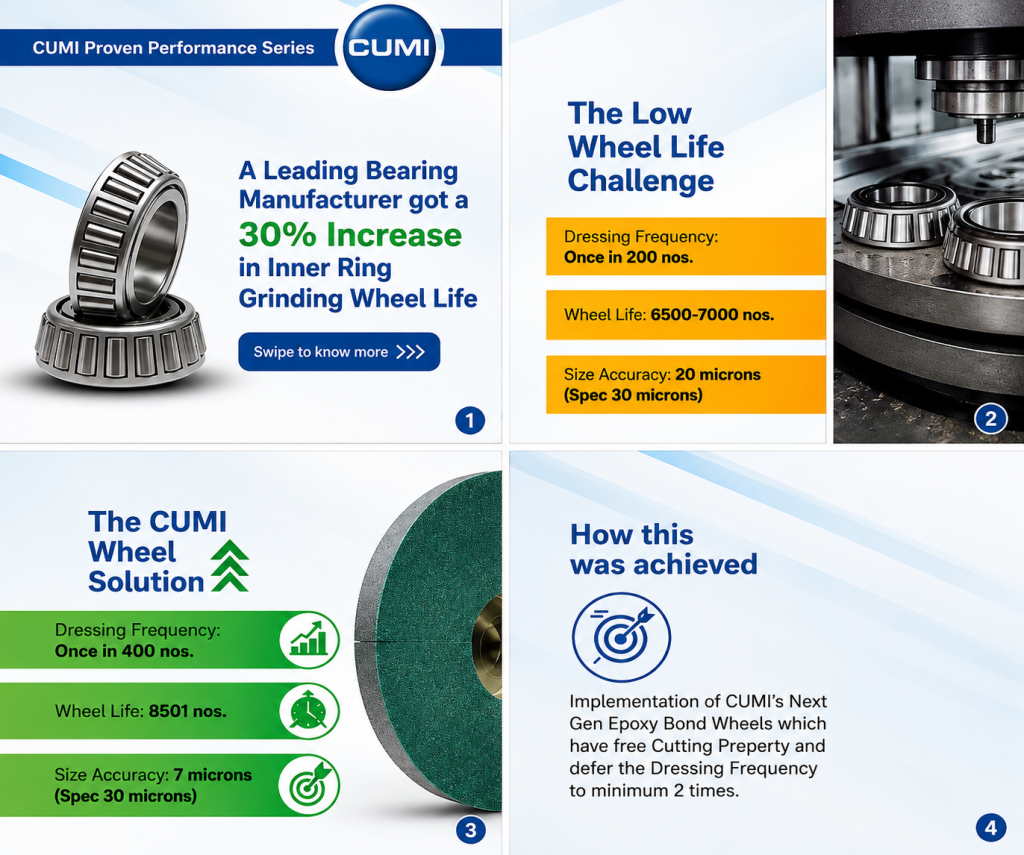
A leading bearing manufacturer wanted to improve productivity without compromising dimensional accuracy. The existing process met quality requirements but required dressing every 200 components and achieved a grinding wheel life of approximately 6,500–7,000 components with a size accuracy of 20 microns against a 30-micron specification.
Engineering the Solution
CUMI recommended a Next Generation Epoxy Bond Grinding Wheel engineered for inner ring grinding. Its free-cutting characteristics were designed to extend dressing intervals, maintain cutting efficiency and improve process stability without changing the existing production line.
Measured Improvements
Following implementation, dressing frequency improved from once every 200 components to once every 400 components. Grinding wheel life increased to 8,501 components and size accuracy improved to 7 microns. These measured improvements resulted in approximately 30% higher grinding wheel life.
Why These Improvements Matter
Longer wheel life and reduced dressing frequency minimise production interruptions, improve machine utilisation, reduce tooling consumption and support higher throughput while maintaining precision.
Industry 4.0 Perspective
Industry 4.0 encourages manufacturers to optimise production using measurable operational data. KPIs such as wheel life, dressing frequency, OEE, process capability and machine availability enable engineering teams to identify improvement opportunities and improve productivity without significant capital investment.
Engineering Perspective
Every grinding application is unique. Workpiece material, machine capability, bond technology, wheel specification, coolant conditions, and dressing parameters all influence performance. The improvements described in this article are based on measured production results from an actual bearing manufacturing application. CUMI’s application engineering approach evaluates the complete grinding process and validates recommendations using objective manufacturing KPIs, helping customers make informed decisions based on measurable outcomes.
Key Takeaways
- Evaluate grinding performance using measurable KPIs rather than wheel price.
• Reduce dressing frequency to improve machine availability.
• Use application-specific abrasive technology.
• Validate improvements through production trials.
• Support Lean Manufacturing and Industry 4.0 initiatives.
Frequently Asked Questions
- Why is wheel life important?
Longer wheel life reduces production interruptions and tooling costs. - Why reduce dressing frequency?
Less dressing increases productive machining time. - How does abrasive selection improve accuracy?
Application-specific wheel specifications maintain stable cutting performance and dimensional consistency.
Conclusion
Engineering-led optimisation of grinding wheel technology can significantly improve wheel life, reduce dressing frequency and enhance precision. This bearing manufacturing application demonstrates how measurable process improvements contribute to higher productivity and support Industry 4.0 objectives.
| Parameter | Before | After |
|---|---|---|
| Dressing Frequency | Once in 200 Components | Once in 400 Components |
| Wheel Life | 6,500–7,000 Components | 8,501 Components |
| Size Accuracy | 20 Microns | 7 Microns |
CUMI Abrasives – Carborundum Universal Limited
Dare House Extension, 4th Floor, 234, NSC Bose Road, Chennai, Tamil Nadu 600001, India
Customer Support: +91-8035120000
Sales: +91-7845121555
Email: [email protected]